how-to
Does Air Sealing Improve Indoor Air Quality
Table of Contents
- How Air Sealing Reduces Indoor Air Pollutants
- Air Sealing and Moisture Control: Preventing Mold Growth
- Common Indoor Air Pollutants in Homes and How Air Sealing Helps
- Mechanical Ventilation Requirements for Airtight Homes
- How to Test Home Airtightness and Verify Results
- The Energy Efficiency vs. Air Quality Trade-Off
- Getting Started: Air Sealing Your Home
- Conclusion
Last Updated: August 29, 2026
How Air Sealing Reduces Indoor Air Pollutants
Air sealing reduces certain pollutants while potentially concentrating others, which is why it must be paired with proper ventilation to deliver genuine health benefits.
When you seal air leaks in your home's building envelope, you prevent uncontrolled infiltration of outdoor contaminants like pollen, dust, and particulate matter that enter through gaps around windows, doors, electrical outlets, and foundation cracks. However, this creates the Ventilation Paradox: a tightly sealed home traps indoor-generated pollutants, cooking odors, volatile organic compounds, carbon dioxide, and moisture unless you introduce controlled mechanical ventilation. Air sealing alone doesn't improve indoor air quality. Air sealing combined with mechanical ventilation does.
The building envelope acts as your home's first defense. When leaky, you get random air exchange driven by wind and stack effect. When tight, you control exactly how much fresh air enters and where it goes. That control unlocks real indoor air quality improvement.
Air Sealing and Moisture Control: Preventing Mold Growth
Moisture management is where air sealing delivers its clearest indoor air quality win. Uncontrolled air infiltration brings moisture into your home during humid seasons, settling on cool surfaces and creating conditions for mold growth.
Mold spores are among the most common indoor air pollutants, triggering asthma, allergies, and respiratory infections. Air sealing reduces moisture infiltration by eliminating random air leakage that carries humid outdoor air into your home. When combined with proper insulation, a sealed building envelope prevents the condensation that feeds mold growth.
Common moisture problems in older, leaky homes include damp basements from humid air infiltrating through foundation cracks, mold on rim joists where warm indoor air meets cold exterior walls, and condensation on windows. Sealing these air leakage points stops the mechanism that delivers moisture to vulnerable areas, resulting in lower relative humidity and slower mold growth.
Common Indoor Air Pollutants in Homes and How Air Sealing Helps
Particulate matter and outdoor pollutants are the clearest wins for air sealing. Dust, pollen, vehicle exhaust particles, and other outdoor contaminants enter through air leaks. A sealed home with mechanical ventilation and HEPA filtration achieves much lower particulate matter levels than a leaky home.
Volatile organic compounds (VOCs) come from both indoor and outdoor sources. Air sealing reduces outdoor VOC infiltration but traps indoor VOCs unless you have mechanical ventilation running. This is why ventilation is non-negotiable in a sealed home.
Carbon dioxide and odors accumulate in sealed homes without ventilation. High CO2 signals poor ventilation overall, and odors from cooking, pets, and human activity linger in stagnant air. Mechanical ventilation removes both.
Radon enters from soil beneath your home. Air sealing helps by reducing uncontrolled air pressure differences that draw radon in, though radon mitigation typically requires active soil depressurization.
Biological pollutants include mold spores, dust mites, pet dander, and bacteria. Air sealing reduces moisture infiltration (controlling mold), and mechanical ventilation with filtration removes airborne biological particles. Dust mite populations decline in the drier, lower-humidity environments that sealed homes maintain.
Air sealing removes the uncontrolled infiltration pathway, but it only improves indoor air quality when paired with mechanical ventilation and source control.
Mechanical Ventilation Requirements for Airtight Homes
Once you seal your home, you must introduce controlled fresh air. This is not optional.
An airtight home needs mechanical ventilation to maintain healthy indoor air quality and prevent moisture accumulation. A typical older home has 7-12 air changes per hour (ACH) due to leakage (ashrae.org). A sealed home might have 2-3 ACH from infiltration alone. Building codes in Canada typically require a minimum of 0.5-1 ACH of controlled mechanical ventilation (nrcan.gc.ca).
Heat Recovery Ventilators (HRVs) extract stale indoor air while capturing heat and transferring it to incoming fresh air, recovering 50-80% of heat energy in heating-dominated climates.
Energy Recovery Ventilators (ERVs) also transfer moisture between air streams and are better suited to humid climates or homes with moisture challenges.
Without one of these systems, a sealed home requires manual window opening, continuous exhaust fan operation (which depressurizes the home), or passive ventilation (which loses heating/cooling energy).
How to Test Home Airtightness and Verify Results
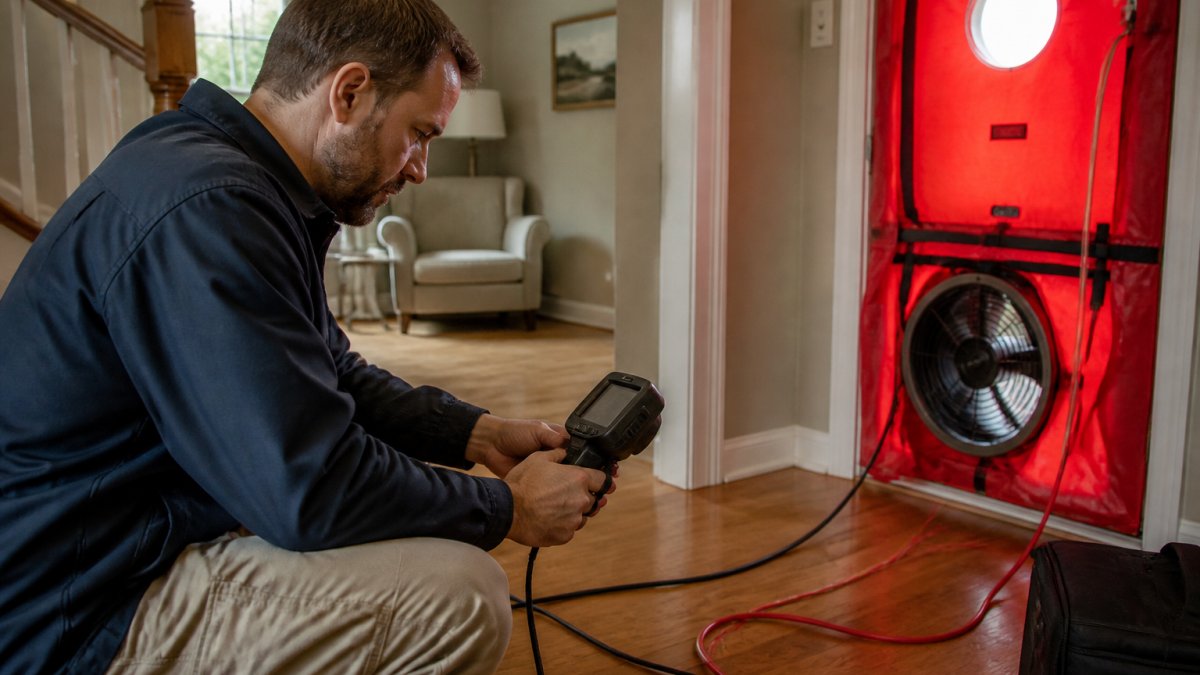
A blower door test is the standard method for measuring home airtightness. It quantifies air leakage and reveals where sealing efforts should focus.
The test involves sealing all intentional openings and using a powerful fan mounted in an exterior door frame to pressurize or depressurize the home. Technicians measure the airflow required to maintain a specific pressure difference (typically 50 Pascals), converted to an air leakage rate expressed as ACH50 (air changes per hour at 50 Pascals).
New construction in Canada typically achieves 3-5 ACH50. High-performance homes target 1-3 ACH50 or lower.

A certified technician will seal windows and doors, block intentional ventilation openings, mount the blower door fan, pressurize the home, measure airflow, conduct a depressurization test, use thermal imaging or smoke to identify leak sources, and provide a written report with recommendations. Testing before and after sealing work quantifies your improvement.
The Energy Efficiency vs. Air Quality Trade-Off
There's a misconception that sealing your home for energy efficiency automatically worsens indoor air quality. The opposite is true if done correctly. The real trade-off is between controlled ventilation and uncontrolled infiltration.
Cost and complexity. Adding mechanical ventilation increases project cost by $3,000-$8,000 depending on home size. Some homeowners resist this cost, hoping air sealing alone improves air quality. It won't without ventilation.
Maintenance burden. Mechanical ventilation systems require regular filter changes and occasional professional service, a trade-off for efficiency and air quality control.
Humidity management. In very cold climates, an HRV works well. In very hot, humid climates, an ERV is necessary. Choosing the wrong system can create humidity problems.
A sealed home with HRV/ERV reduces heating and cooling energy use by 20-40% compared to a leaky home (energystar.gov). The air quality benefit depends entirely on whether you add mechanical ventilation.
Getting Started: Air Sealing Your Home
Step 1: Test your home's current airtightness. Hire a certified blower door technician to measure your ACH50 and identify major leak sources. This $300-$500 investment guides everything that follows.
Step 2: Prioritize sealing locations. Focus on rim joists and band boards, electrical outlets, gaps around windows and doors, ductwork and mechanical penetrations, attic access hatches, and basement rim joists.
Step 3: Choose air sealing materials. Use spray polyurethane foam for large gaps, caulk for smaller gaps, weatherstripping for windows and doors, rigid insulation for basement rim joists, and tape and sealant for ductwork.

Step 4: Plan for mechanical ventilation. Decide whether you'll install an HRV or ERV and size it based on your home's volume and occupancy.
Step 5: Execute sealing and ventilation together. Don't seal first and add ventilation later. Install both as part of the same project.
Step 6: Retest after sealing. A post-sealing blower door test confirms your work reduced air leakage and verifies your ventilation system is functioning.
Common mistakes include sealing without testing, sealing without ventilation, using the wrong sealant, blocking intentional vents without alternatives, and undersizing your mechanical ventilation system.
Does air sealing improve indoor air quality? When done properly, with mechanical ventilation, moisture control, and post-sealing testing, absolutely. If you're planning a renovation or new build and want to understand how air sealing fits your specific situation, our Red Seal certified team can walk you through the process with transparent project tracking every step of the way.
Frequently Asked Questions
Q: Does air sealing actually improve indoor air quality?
A: Yes, air sealing reduces the infiltration of outdoor dust, pollen, and particulate matter into your home. By sealing air leakage points, you prevent uncontrolled entry of pollutants and outdoor contaminants. However, air sealing alone isn't enough, you also need proper mechanical ventilation to remove indoor pollutants like carbon dioxide and volatile organic compounds. The combination of a tight building envelope with controlled ventilation creates the best indoor air quality.
Q: What are common indoor air pollutants in homes and how does air sealing help?
A: Common indoor pollutants include dust, pollen, pet dander, mold spores, volatile organic compounds (VOCs) from paints and furnishings, and radon. Air sealing blocks outdoor pollutants like pollen and dust from entering through cracks and gaps. It also prevents moisture infiltration that causes mold growth. For indoor-generated pollutants, air sealing works best when paired with mechanical ventilation that removes stale air and introduces filtered fresh air.
Q: Do I need mechanical ventilation if I seal my home's air leaks?
A: Yes. When you seal air leaks, you reduce uncontrolled air exchange, which means outdoor air no longer naturally enters through gaps. Without mechanical ventilation in an airtight home, indoor pollutants accumulate and humidity rises, creating conditions for mold. Mechanical ventilation requirements for airtight homes typically include an energy recovery ventilator (ERV) or heat recovery ventilator (HRV) that exchanges stale indoor air for fresh outdoor air while recovering energy, maintaining both air quality and comfort.
Q: How can I test my home's airtightness?
A: A blower door test is the standard method to measure how to test home airtightness. A professional technician seals your front door with a fan that pressurizes or depressurizes the home while measuring air leakage. Results show your air changes per hour (ACH) and identify major leakage points using smoke or thermal imaging. This data guides where to focus air sealing efforts and confirms whether your building envelope meets high-performance standards.
This article was written using GrandRanker