 comparison
Best Insulation Materials for Cold Climate Home Additions
Table of Contents
- Insulation Materials for Cold Climate Home Additions: Comparison Overview
- Spray Foam vs Fiberglass Insulation
- R-Value Requirements for Home Additions in Cold Climates
- Stone Wool and Cellulose: Alternative High-Performance Options
- Vapor Barrier Requirements for Renovations and Thermal Bridging
- Air Sealing and Insulation Voids: Critical Details for Cold Climate Performance
- Professional Installation vs. DIY: Risks and Building Code Compliance
- Conclusion
Last Updated: August 19, 2026
Insulation Materials for Cold Climate Home Additions: Comparison Overview
Choosing the right insulation material for a cold climate home addition is one of the most consequential decisions you'll make during renovation planning. The wrong choice compromises energy efficiency, creates moisture problems, and undermines your entire envelope strategy. Most people focus on R-value alone and miss the structural details that determine long-term performance.
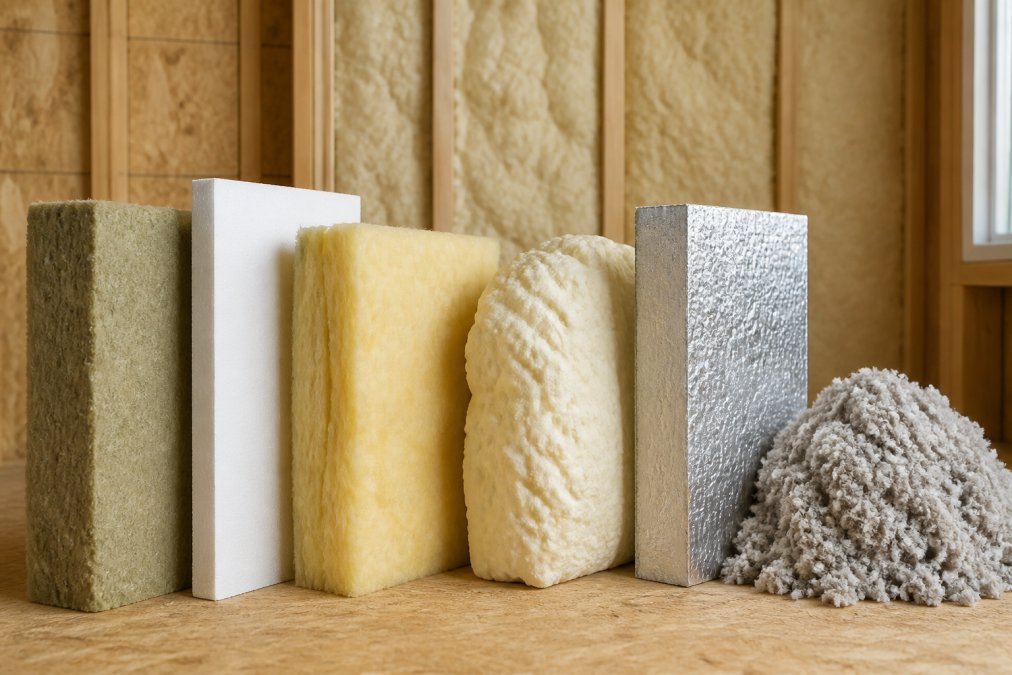
This guide covers the four insulation materials that perform best in cold climates: spray foam, fiberglass batts, stone wool, and cellulose. Each has genuine strengths and real limitations. Rather than recommending one universal solution, we'll show you how to match material choice to your specific addition type, budget, and performance goals.
Cold climate insulation selection requires balancing three competing priorities: thermal resistance (R-value), air sealing capability, and moisture management. A material with excellent R-value but poor air sealing leaves gaps that negate its thermal benefit.
| Material | R-Value per Inch | Air Sealing | Moisture Resistance | Best Climate Use |
|---|---|---|---|---|
| Closed-cell spray foam | 6.0-7.0 | Excellent | Excellent | All cold climates |
| Fiberglass batts | 3.2-3.8 | Poor (requires sealing) | Fair | Cold climates with vapor barrier |
| Stone wool (ROCKWOOL) | 3.5-4.0 | Moderate | Excellent | Cold climates with high moisture risk |
| Cellulose (dense-pack) | 3.6-3.8 | Good | Fair (treated) | Cold climates with air sealing |
Spray Foam vs Fiberglass Insulation
Spray foam and fiberglass represent two fundamentally different approaches to insulation. Spray foam seals as it insulates, expanding to fill cavities and creating an air barrier in a single application. Fiberglass batts insulate only; they require separate air sealing to prevent infiltration.
Spray Foam Performance and Air Sealing
Closed-cell spray polyurethane foam delivers the highest R-value per inch available in residential applications, typically 6.0 to 7.0 per inch. More importantly, it seals air leaks as it cures. When spray foam expands against framing, rim joists, and penetrations, it eliminates convection currents that would otherwise bypass loose-fill or batt insulation.
In cold climates, this air-sealing capability prevents warm interior air from reaching cold surfaces inside the wall cavity, condensing into liquid water, and creating mold conditions. Spray foam's closed-cell structure resists moisture infiltration while its expansion fills gaps that fiberglass cannot reach.
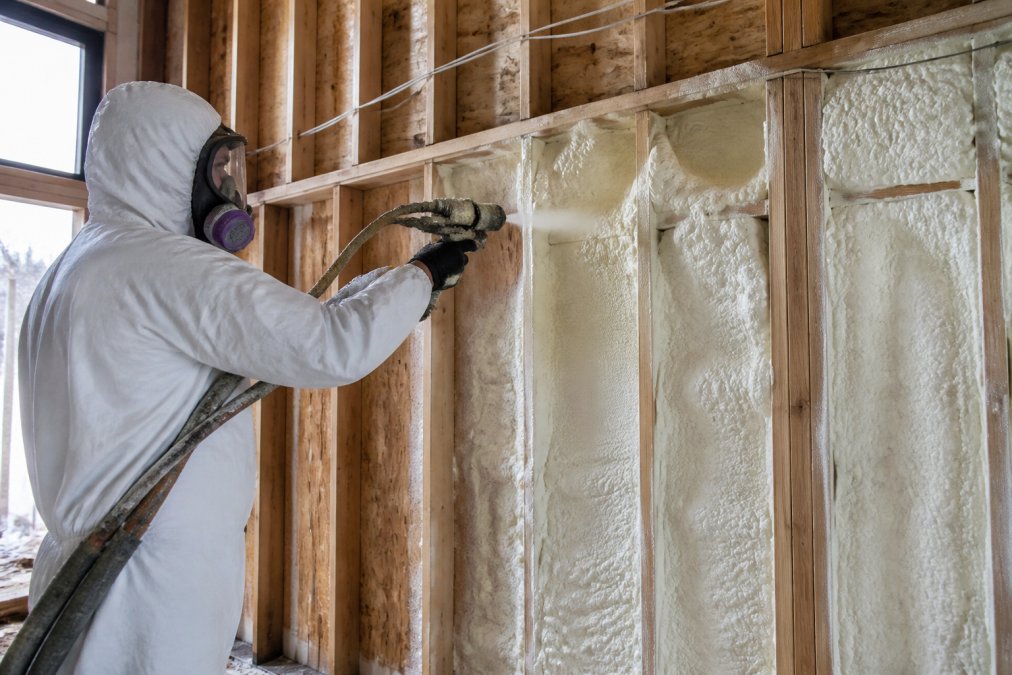
The trade-off is cost and installation requirements. Spray foam typically costs more per square foot than fiberglass, and installation requires certified applicators. Improper application or incomplete fill can reduce performance. Professional installation is not optional; DIY spray foam almost always fails.
For home additions in sub-zero climates where thermal bridging and air infiltration represent the largest energy losses, closed-cell spray foam is often the highest-performing choice.
Fiberglass Batts and Installation Considerations
Fiberglass batts are the most widely used residential insulation material. They're inexpensive, easy to handle, and available in standard sizes that fit between typical stud spacing of 400 mm and 600 mm. Owens Corning PINK NEXT GEN FIBERGLAS insulation uses advanced fiber technology that allows batts to recover and stay in place without settling, and contains over 73% recycled content.
The critical limitation: fiberglass alone does not seal air leaks. A perfectly installed batt still allows air to flow around its edges if the cavity isn't sealed separately. In cold climates, you must combine fiberglass with air sealing, caulk, spray foam, or gasket tape around the batt perimeter to achieve rated performance.
Fiberglass's lower R-value per inch (3.2-3.8) means you need thicker cavities to match spray foam performance. A 2x6 wall with 140 mm of fiberglass yields roughly R-19 to R-21. The same cavity with spray foam delivers R-33 to R-42. In constrained spaces like rim joists or band beams, spray foam's density advantage becomes significant.
Installation quality determines fiberglass performance more than material quality. Batts compressed into cavities or left with gaps at edges lose 15 to 30 percent of their rated value. For budget-conscious additions where you can ensure professional installation and rigorous air sealing, fiberglass remains viable. For high-performance additions where thermal bridging is a concern, spray foam's integrated air sealing justifies the premium.
R-Value Requirements for Home Additions in Cold Climates
R-value measures thermal resistance, the material's ability to slow heat transfer. Higher R-value means slower heat loss, but the relationship is not linear. Doubling R-value does not double energy savings.
Cold climate building codes typically mandate minimum R-values for different building assemblies. In Canada, the National Building Code specifies R-values based on heating degree-days. Pictou County, located in a cold climate zone, generally requires R-20 to R-28 for above-grade walls in new construction, and R-28 to R-40 for attics in additions.
Most cold climate additions benefit from targeting R-30 to R-40 in above-grade walls. This range captures diminishing returns; additional R-value beyond R-40 yields minimal annual energy savings in most scenarios. For attics and cathedral ceilings, R-40 to R-60 is standard.
Thermal bridging, heat transfer through structural framing, reduces effective R-value by 10 to 20 percent depending on frame spacing and material. A wall insulated to R-20 with wood studs every 400 mm delivers closer to R-16 effective performance. Accounting for thermal bridging means targeting higher nominal R-values than your effective target.
Stone Wool and Cellulose: Alternative High-Performance Options
Beyond spray foam and fiberglass, stone wool and cellulose offer distinct advantages for cold climate additions.
ROCKWOOL COMFORTBATT for Fire and Moisture Resistance
ROCKWOOL COMFORTBATT is a semi-rigid stone wool batt designed for exterior walls and cavities in new construction and renovations. The material is non-combustible with a melting temperature of 1177°C, making it inherently fire-resistant without chemical additives. It resists moisture, mold, and mildew, maintaining insulating value even in damp conditions, a significant advantage in cold climates where seasonal moisture fluctuations are common.
Stone wool's R-value ranges from 3.5 to 4.0 per inch, comparable to fiberglass but superior in moisture and fire performance. The semi-rigid structure provides a snug fit in cavities, reducing settling.
The trade-off is cost. ROCKWOOL COMFORTBATT is more expensive per square foot than fiberglass, though less than spray foam. Installation is straightforward for contractors familiar with batt insulation.
For cold climate additions where fire resistance is a concern, cathedral ceilings, or homes in wildfire-prone regions, stone wool's non-combustibility and moisture resistance justify the premium.
Climatizer Plus Cellulose for Sustainability
Climatizer Plus cellulose insulation is manufactured from a minimum of 85% post-consumer recycled newsprint and boxboard, making it the lowest-embodied-carbon insulation option available. It achieves an R-value of 3.59 per inch and provides exceptional sound absorption, reducing sound transmission by up to 60 percent.
Cellulose is treated with non-toxic additives for fire, moisture, mold, and pest resistance. In cold climates, these treatments protect against moisture infiltration risks. The material can be blown in, dense-packed, or spray-applied, offering installation flexibility.
The limitation: cellulose can settle over time, reducing R-value if installation doesn't account for future settlement. Dense-packing, compressing cellulose to higher density during installation, minimizes settling but requires specialized equipment and expertise.
For environmentally conscious homeowners prioritizing carbon footprint, Climatizer Plus cellulose delivers meaningful sustainability benefits if dense-packed correctly. Installation must be performed by contractors experienced with dense-pack cellulose.
Vapor Barrier Requirements for Renovations and Thermal Bridging
Cold climate additions face a specific moisture challenge: warm interior air carries humidity that can condense inside wall cavities when it reaches cold surfaces. A vapor barrier, typically polyethylene film or kraft paper facing, slows this moisture migration, allowing the wall to dry before condensation occurs.
In cold climates, the vapor barrier should be on the warm side of the insulation (interior-facing). This positioning slows inward moisture diffusion while allowing the exterior sheathing to dry to the outside if moisture does penetrate. Placing a vapor barrier on the cold side traps moisture between the barrier and the insulation, creating mold conditions.
Many fiberglass batts come with kraft paper facing that serves as a vapor retarder, sufficient to slow moisture migration in many applications. For additions in very cold climates, a separate polyethylene vapor barrier may be warranted.
Thermal bridging becomes more consequential when combined with moisture risk. A cold stud in an exterior wall becomes a condensation point if interior humidity is high. Addressing thermal bridging requires either insulating the exterior of the framing with rigid foam board or continuous spray foam, or using insulation materials with lower thermal conductivity than wood.
In practice, this means avoiding thin insulation layers in cold climate additions. A 2x6 wall with 140 mm of insulation reduces the stud's relative impact compared to a 2x4 wall. For maximum thermal performance, exterior rigid foam insulation (25 mm to 50 mm) over the sheathing improves overall envelope performance by 15 to 25 percent.
Air Sealing and Insulation Voids: Critical Details for Cold Climate Performance
Air sealing is the single most underestimated detail in cold climate insulation strategy. An addition insulated to R-40 but riddled with air leaks will lose more heat than an addition insulated to R-25 with meticulous air sealing. Air infiltration bypasses insulation entirely, delivering uninsulated air directly to the interior.
Insulation voids occur when batts don't fit cavities precisely, are compressed around electrical boxes and plumbing penetrations, or when irregular cavities are incompletely filled. Each void creates a convection loop that carries heat away.
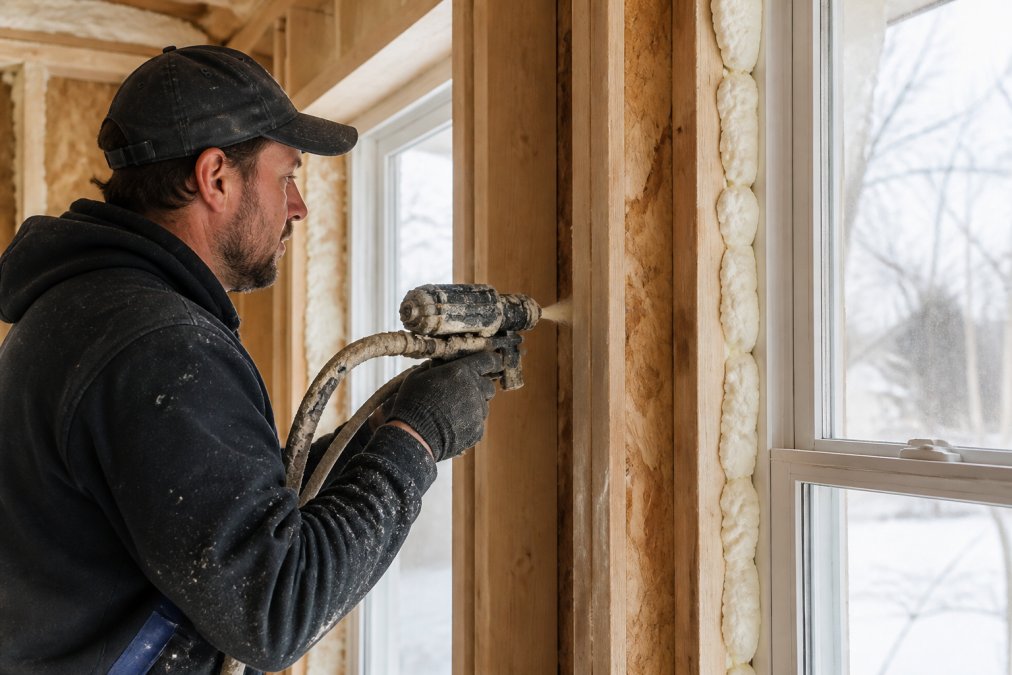
Sealing voids requires a multi-layer approach. Caulk or gasket tape seals small gaps around batt perimeters. Expanding spray foam fills larger voids around windows, doors, rim joists, and penetrations. Rigid foam board seals continuous thermal bridges.
Cold climate additions benefit from a continuous air barrier, a sealed plane that runs unbroken around the entire thermal envelope. This can be the interior drywall with careful caulking, the exterior sheathing with sealed seams, or a dedicated air barrier membrane. The key is continuity; a single unsealed penetration can compromise an otherwise excellent air barrier.
Testing air sealing effectiveness requires blower door testing, a fan-based method that measures air leakage rate. Cold climate additions should target 5 air changes per hour or lower at 50 pascals of pressure (ACH50 ≤ 5). Additions exceeding 7 ACH50 typically have unaddressed air leaks that will compromise energy performance.
Professional Installation vs. DIY: Risks and Building Code Compliance
The difference between professional and DIY insulation installation is often the difference between rated performance and actual performance.
Spray foam installation requires certification, specialized equipment, and trained applicators. Improper mixing ratios, inadequate expansion, or moisture during curing can create voids or reduce R-value. DIY spray foam is not realistic; the performance penalty for mistakes is severe.
Fiberglass batt installation appears straightforward but has hidden complexity. Batts must be fitted snugly without compression, air-sealed around edges, and installed with facing oriented correctly. Compressed batts lose 15 to 30 percent of rated R-value. Professional installation ensures consistent quality and proper air sealing.
Cellulose dense-packing requires specialized blowing equipment and expertise in managing settling rates. DIY cellulose installation often results in inconsistent density and unpredictable settling.
Stone wool batts are the most DIY-friendly insulation material. The semi-rigid structure resists compression, and installation follows standard batt procedures. However, professional installation still ensures proper air sealing and vapor barrier integration.
Building code compliance for home additions requires documentation of insulation type, R-value, air sealing method, and vapor barrier placement. Municipal inspectors verify that installed insulation matches approved plans. Professional contractors carry liability insurance and maintain compliance documentation; DIY installations often lack this protection.
For complex additions in cold climates, cathedral ceilings, irregular cavities, or high-performance requirements, professional installation is essential. For straightforward additions with simple geometries, DIY fiberglass or stone wool installation is feasible if you commit to rigorous air sealing and quality verification.
Conclusion
Selecting insulation materials for a cold climate home addition requires balancing R-value, air sealing, moisture management, and installation complexity. Spray foam delivers the highest performance for thermal bridging mitigation and air sealing but demands professional installation. Fiberglass offers affordability and ease of handling but requires meticulous air sealing. Stone wool combines moisture resistance and fire safety with moderate cost. Cellulose prioritizes sustainability while requiring specialized dense-pack installation.
At Timeless General Contracting, homeowners who invest in professional installation, comprehensive air sealing, and proper vapor barrier integration see energy bills 20 to 35 percent lower than code-minimum additions. The upfront cost difference is recovered in energy savings within 5 to 8 years.
Our Client Project Portal keeps you informed throughout the insulation phase, material selection, installation progress, and third-party verification testing. We combine 25 years of Red Seal-certified expertise with transparent real-time tracking. The National Building Code of Canada specifies thermal resistance requirements based on climate zone and building assembly. We ensure your addition meets or exceeds these standards while optimizing for your long-term energy performance and comfort.
Contact Timeless General Contracting to discuss your cold climate addition insulation strategy. We'll evaluate your specific needs, recommend the material combination that delivers the best performance-to-cost ratio, and manage professional installation with full transparency.
Frequently Asked Questions
What is the best insulation material for cold climates?
The best choice depends on your priorities. Spray foam offers the highest R-value per inch and superior air sealing, critical for preventing heat loss in sub-zero temperatures. Stone wool (ROCKWOOL) provides excellent fire resistance and moisture management without the cost premium. Fiberglass batts offer affordability but require careful installation to avoid thermal bridging. For cold climates, prioritize materials with high R-value, moisture resistance, and proper vapor barrier installation to prevent condensation damage.
What R-value do I need for a home addition in a cold climate?
Building code requirements vary by region, but cold climates typically require R-20 to R-30 for exterior walls and R-40 to R-50 for attics. Your specific R-value requirements for home additions depend on local building codes and the addition's purpose. Consult your local authority having jurisdiction (AHJ) or a Red Seal certified contractor to confirm exact requirements. Higher R-values reduce energy loss through the building envelope and improve long-term energy efficiency.
Do I need a vapor barrier if I'm using spray foam insulation?
Closed-cell spray foam acts as its own vapor barrier due to low permeability, so additional barriers are often unnecessary. Open-cell spray foam and fiberglass batts require a separate vapor retarder on the warm (interior) side of walls. Vapor barrier requirements for renovations depend on your climate zone and wall assembly design. Improper vapor management causes moisture accumulation, mold growth, and structural damage. Have your contractor verify requirements against local building codes before installation.
What causes insulation settling in cold climates, and how do I prevent it?
Loose-fill insulation like cellulose settles over time due to vibration, gravity, and temperature fluctuations, reducing R-value by 10-20% if not accounted for during installation. Dense-pack cellulose resists settling better than standard loose-fill. Fiberglass batts and rigid foam board do not settle. If choosing loose-fill, contractors should install 15-20% extra material to compensate for settling. Professional installation ensures proper compaction and accounts for settling in cold climates.
This article was written using GrandRanker