 comparison
Alternatives to Construction Loans for Custom Builds
Table of Contents
- Why Homeowners Seek Alternatives to Traditional Construction Loans
- Progress Draw Mortgage vs Completion Mortgage: Understanding the Traditional Baseline
- Using a HELOC for Custom Home Build Financing
- Private Lending for Home Construction: Speed and Flexibility
- Personal Lines of Credit and Asset-Based Financing
- Comparison Table: Key Financing Alternatives at a Glance
- Choosing the Right Financing Strategy for Your Custom Build
- Frequently Asked Questions
Last Updated: September 17, 2026
Why Homeowners Seek Alternatives to Traditional Construction Loans
Many homeowners discover that conventional construction mortgages don't fit their situation due to timing constraints, income verification challenges, or project complexity.
Alternatives construction loans address real gaps in how institutional lenders approach custom builds, offering solutions that better match specific circumstances.
Standard construction mortgages require detailed plans, builder approval, inspections, and strict underwriting. For self-employed professionals, those with non-traditional income, or unique project specifications, this becomes a barrier.
Private lenders, home equity solutions, and asset-based financing now offer pathways traditional banks don't provide, allowing you to match financing to your timeline and situation.
Progress Draw Mortgage vs Completion Mortgage: Understanding the Traditional Baseline
Understanding traditional construction financing, progress draw mortgages and completion mortgages, provides the baseline for evaluating alternatives construction loans.
A progress draw mortgage releases funds in stages as work completes, with the lender inspecting and approving each phase. You pay interest-only during construction, then convert to a standard mortgage upon completion.
A completion mortgage provides a single advance at project completion, with permanent financing secured upfront and drawn as construction proceeds.
Both require extensive documentation, builder approval, multiple appraisals, and 60-90 day timelines, deal-breakers for non-standard income profiles or unconventional projects.
Alternatives construction loans bypass institutional gatekeeping but introduce trade-offs: higher rates, shorter terms, or different collateral requirements.
Using a HELOC for Custom Home Build Financing
A HELOC is one of the most accessible alternatives construction loans for homeowners with significant equity, allowing you to borrow against existing home equity instead of securing a dedicated construction loan.
Your lender establishes a credit limit based on home value minus mortgage balance. You draw funds as needed, paying interest only on borrowed amounts at variable rates tied to prime.
HELOCs carry lower rates than specialized construction products, avoid draw inspections, and fund within days of application.
Variable rates can increase with prime rate changes. Declining home values shrink available credit. Carrying debt on two properties simultaneously affects debt-to-income ratio and permanent mortgage capacity.
HELOCs work best with 20%+ equity, stable income supporting two properties, and comfort with variable rate risk.
Private Lending for Home Construction: Speed and Flexibility
Private lenders and MICs focus on property value and project viability rather than income verification, making private lending a powerful alternatives construction loans option for borrowers declined by traditional banks.
Private lenders underwrite based on completed project value. If your build will be worth $800,000 and you're borrowing $600,000, the property's worth as collateral is the primary concern, not employment status or income complexity.
Private lenders fund within 2-3 weeks versus 60-90 days for banks, critical if your builder has limited start windows or you need quick land closing.
Private lending costs 8-15% plus 1-3% origination fees, with 12-24 month terms requiring clear permanent financing paths. Some lenders require approved builders, limiting flexibility.
Private lending excels for borrowers exhausted traditional options, need quick capital, or have unconventional specifications. It's expensive but fast.
Personal Lines of Credit and Asset-Based Financing
Personal lines of credit and asset-based financing represent additional alternatives construction loans for specific situations, with asset-based financing addressing a gap most builders overlook.
A personal line of credit borrows at personal creditworthiness (Prime + 2-7%) with no appraisals or inspections. Most cap at $50,000-$100,000 for supplemental funding, though strong credit (750+) may access $250,000 unsecured loans.
Asset-based financing pledges liquid assets, investment portfolios, GICs, cash equivalents, as collateral, allowing construction capital access without liquidating investments and triggering capital gains tax.
Pledge a $300,000 portfolio as collateral and borrow 50-70% ($150,000-$210,000) at Prime + 1-3% without selling shares. Investments remain invested and compounding while you access construction liquidity.
Risks include margin calls if pledged assets drop 20%, creating timing risk during construction. You avoid capital gains tax but must repay within 12-36 months, requiring clear exit strategy via permanent financing or cash flow.
Asset-based financing works best for high-net-worth individuals ($500,000+ net worth) with substantial portfolios who can tolerate short-term debt and want to preserve investments, particularly attractive for self-employed professionals.
Both work best as supplemental financing for specific phases. For the right borrower, asset-based financing offers tax-efficient paths traditional lending doesn't provide.
Comparison Table: Key Financing Alternatives at a Glance
| Financing Option | Interest Rate Range | Speed to Funding | Best For | Key Limitation |
|---|---|---|---|---|
| HELOC | Prime + 0.5-1.5% | 1-2 weeks | Homeowners with 20%+ equity | Variable rates; requires existing property |
| Private Mortgage | 8-15% + fees | 2-3 weeks | Borrowers declined by banks | High cost; short terms (12-24 months) |
| Personal Line of Credit | Prime + 2-7% | 1-2 weeks | Supplemental funding or smaller builds | Low borrowing limits ($50K-$100K) |
| Asset-Based Financing | Prime + 1-3% | 2-3 weeks | High-net-worth individuals | Requires substantial liquid assets; margin call risk |
Choosing the Right Financing Strategy for Your Custom Build
The right alternatives construction loans choice depends on four core factors: your timeline, your financial situation, your project specifications, and critically, the tax and insurance implications of your chosen structure.
Timeline and Speed Considerations
Private lending and HELOCs fund fastest (1-3 weeks). Traditional bank loans take 60-90 days but offer lower rates. Personal lines of credit split the difference with borrowing limits. Asset-based financing funds in 2-3 weeks.
Collateral Position and Cost Trade-offs
With 20%+ equity, HELOCs cost Prime + 0.5-1.5%. With $300,000+ investments, asset-based financing preserves positions at Prime + 1-3%. Without either, private lending costs 8-15% plus 1-3% fees. A $500,000 HELOC at Prime + 1% costs ~$27,500 annually; private lending costs $40,000-$75,000 plus $5,000-$15,000 in fees.
Project Complexity and Builder Requirements
Standard builds fit traditional mortgages. Unusual specs, owner-builder scenarios, or tight timelines require private lenders. Supplemental funding fits personal lines of credit. Owner-builders benefit from private lenders and HELOCs' flexibility versus institutional requirements for approved contractors.
Tax Implications: A Critical Gap Most Builders Overlook
Different financing structures carry different tax consequences, and this is where many custom builders make costly mistakes.
HELOC interest is not tax-deductible for personal residences but is deductible for rental or investment properties, critical if building on investment property or planning to rent initially.
Private lending interest is deductible only for income-generating uses. However, flexible fund use may allow partial deductions if you use borrowed funds to pay down non-deductible debt, discuss with an accountant before proceeding.
Asset-based financing defers capital gains tax by not selling investments, but dividends remain taxable and liquidating to repay triggers capital gains. Tax deferral is temporary, not permanent.
Personal lines of credit for personal residence construction carry no deduction, but portions may be deductible if funding business or investment activities (rental suites, commercial space).
Consult an accountant about tax implications before committing, a cheap interest rate may be expensive after tax considerations.
Owner-Builder Insurance and the Financing-to-Execution Bridge
Financing is only half the equation; builder's risk insurance is a hidden friction point many overlook.
Owner-builder insurance (course-of-construction insurance) is mandatory for mortgage approval and draw disbursement if you're acting as your own builder or using unlicensed contractors.
Owner-builder insurance costs 0.5-1.5% of project cost ($2,500-$7,500 for a $500,000 build). Factor this into total financing need upfront.
Insurance requirements vary: HELOCs typically don't require builder's risk but may require proof of future coverage. Private lenders almost always require owner-builder insurance naming them as loss payee (100-110% of loan). Traditional loans require builder's risk with lender as loss payee. Asset-based financing varies, clarify before committing.
Add owner-builder insurance costs to total financing need. A $500,000 borrow with $5,000 insurance requires $505,000 total. Some lenders roll this in; others require separate payment.
Putting It Together: A Decision Framework
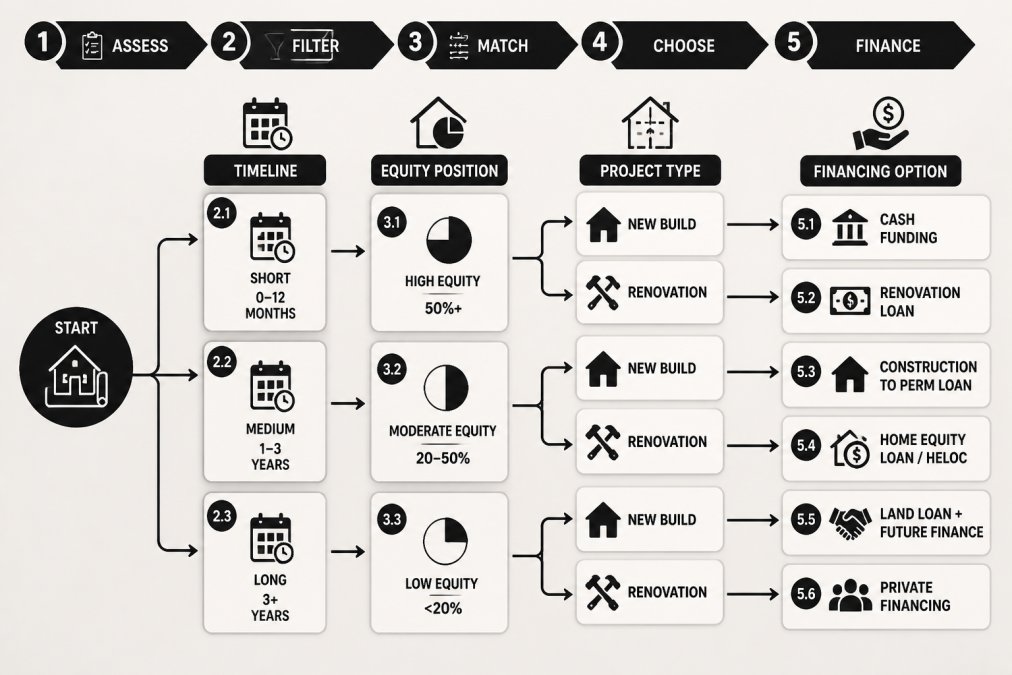
Start with timeline: private lending and HELOCs move fastest; traditional loans take 60-90 days but offer lower rates. Evaluate collateral and tax situation together: 20%+ equity favors HELOCs; substantial investments favor asset-based financing; neither favors private lending. Consider project complexity and insurance requirements. Consult an accountant about tax implications, a 1% rate difference often matters less than tax deductions. Your builder's experience with different financing structures affects coordination and draw management. Balance cost, convenience, tax efficiency, and insurance requirements for your specific circumstances.
Frequently Asked Questions
What are the primary differences between a progress-draw mortgage and a completion mortgage?
A progress-draw mortgage disburses funds in stages as construction milestones are met, with lender inspections at each phase. A completion mortgage waits until the home is finished before releasing the full loan amount. Progress draws align payments with actual construction expenses, while completion mortgages suit builders who can self-fund through construction and refinance upon completion. Progress draws typically carry lower interest rates but require more documentation and inspection oversight.
Can I use a home equity line of credit (HELOC) to fund a custom build?
Yes, a HELOC can fund a custom build if you have sufficient equity in an existing property. HELOCs offer revolving access to funds at variable interest rates, typically lower than specialized construction loans. You draw only what you need as construction progresses, paying interest only on the amount borrowed. However, variable rates can increase your monthly costs, and you must qualify based on your existing home's equity and your creditworthiness. This option works well for homeowners who want to avoid the complex draw-schedule inspections required by traditional construction lenders.
What are the risks of using private lenders for custom home construction?
Private lending offers speed and flexibility but comes with significantly higher interest rates, typically 8% to 15%, plus origination fees. Loan terms are shorter, usually 12 to 24 months, requiring a refinance or repayment plan before construction ends. Private lenders focus on property value rather than income verification, making qualification easier, but the higher cost of capital can add substantial expense to your project. Ensure any private lender is regulated under provincial mortgage broker acts to protect yourself.
How does owner-builder insurance apply to custom construction financing?
Owner-builder insurance protects your construction project from liability and property damage during the build phase. Some traditional lenders require this coverage as a condition of financing. Non-traditional lenders like private mortgage companies may have different requirements. Insurance costs vary based on project scope and risk profile. You should verify insurance requirements with your chosen lender before committing, as this affects your total project budget and financing structure.