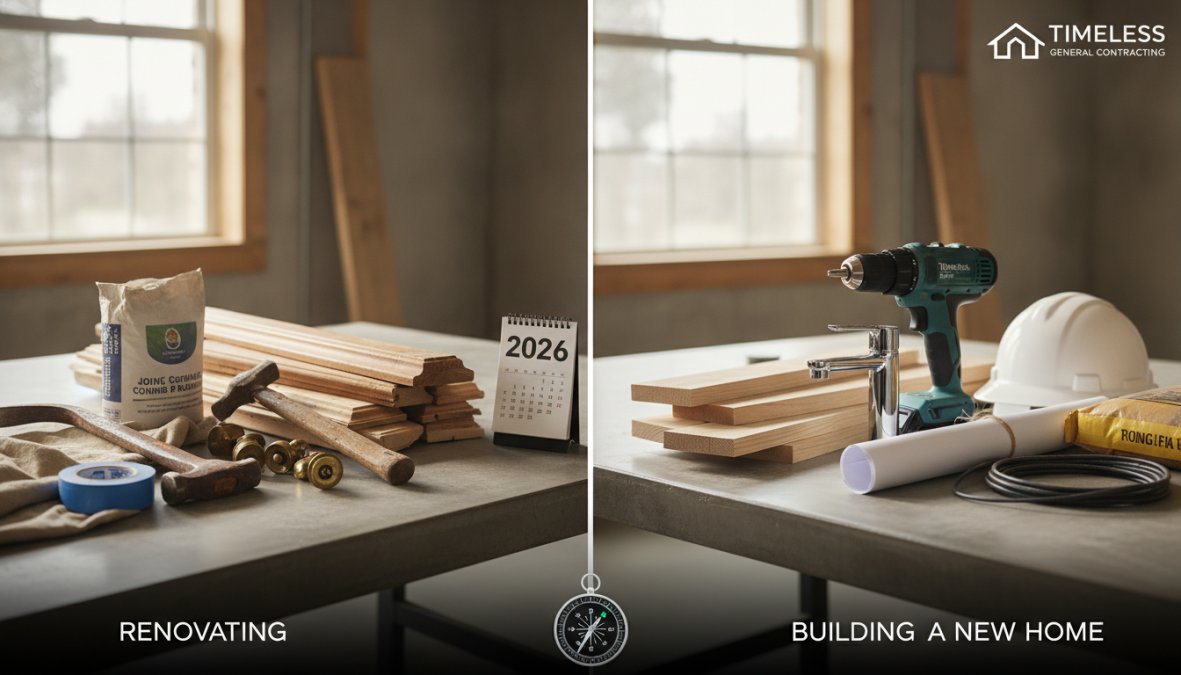
 comparison
Renovating vs Building a New Home: 2026 Decision Guide
Table of Contents
- Renovating vs Building a New Home: Key Differences at a Glance
- Cost to Renovate vs Build New: Upfront Investment Breakdown
- New Build vs Renovation Timeline: Project Duration Compared
- Pros and Cons of Renovating vs Building: Weighing Your Options
- Return on Investment: Renovating vs Building New for Property Value
- Structural Integrity, Permits, and Regulatory Considerations
- Tax Incentives and Government Support for Your Choice
- The Middle Path: Modular and Prefabricated Additions
Last Updated: July 22, 2026
When deciding between renovating vs building a new home, homeowners face one of the most consequential decisions of their lives. This choice affects your immediate finances, long-term property value, timeline to occupancy, and ability to customize your living space. At Timeless General Contracting, we've guided hundreds of Pictou County families through this exact decision. Both approaches have legitimate advantages and serious drawbacks. A renovation can preserve neighborhood character, but often uncovers hidden structural problems that balloon costs. New construction offers modern building codes and energy efficiency, but requires significantly more upfront capital and a longer timeline.
Renovating vs Building a New Home: Key Differences at a Glance
A renovation updates an existing structure, while new construction means demolishing what's there and building from the foundation up according to current codes and your specifications. A renovation works with existing constraints, foundation depth, wall placement, roof pitch, utility locations. New construction lets you optimize everything, but requires thousands of upfront decisions. According to research from the National Association of Home Builders, new construction typically commands a premium in strong seller's markets, while renovations offer better value where existing inventory is plentiful. In 2026, the Pictou County market leans toward existing homes, making renovation more competitive on price.
Cost to Renovate vs Build New: Upfront Investment Breakdown
Cost comparison is where most homeowners get blindsided. The numbers look simple until you start digging.
Renovation Expenses: Demolition, Materials, and Labor
A typical renovation budget includes demolition, structural repairs, materials, labor, permits, and contingency. Demolition alone can run $5,000 to $15,000. Material costs depend on finish level: a basic kitchen refresh costs $15,000 to $25,000; a full renovation exceeds $50,000. Bathrooms follow similar patterns: basic updates run $8,000 to $15,000; luxury renovations hit $30,000 or more per bathroom.
Labor represents the largest variable. Skilled tradespeople command competitive rates, and renovation work is inherently less efficient than new construction because workers must adapt to existing conditions. A contractor might discover that a wall you wanted to remove is load-bearing, requiring expensive structural support. Plumbing and electrical systems might need complete replacement because existing infrastructure is obsolete.
Most renovation projects encounter surprises: rotted subfloors, outdated wiring, pest damage. Industry practice recommends setting aside 15-25% of your total renovation budget as contingency. If your planned renovation is $100,000, budget realistically for $115,000 to $125,000.
New Construction Costs: Site Preparation and Infrastructure
New construction has different cost drivers. Site preparation, clearing, grading, soil testing, and foundation work typically run $15,000 to $30,000 depending on soil conditions. Material costs for new construction are often more predictable because builders negotiate bulk rates with suppliers. Labor costs for new construction are generally lower per square foot than renovation because work is sequential and efficient. However, the total labor bill is higher because you're building more. New construction also requires extensive permitting and inspections at multiple phases, adding $2,000 to $5,000 typically.
Contingency Budgets and Unexpected Expenses
Contingency budgets operate differently in renovation versus new construction. In renovation, unexpected expenses come from discovery, you don't know what's inside walls until you open them. In new construction, unexpected expenses typically come from design changes or scope creep.
| Project Phase | Renovation Contingency | New Construction Contingency | Reason |
|---|---|---|---|
| Pre-construction | 5% | 10% | Design/permitting changes |
| During construction | 20% | 5% | Discovery vs. scope creep |
| Final phase | 5% | 5% | Punch-list items, final inspections |
| Total Reserve | 20-25% | 10-15% | Renovation has more unknowns |
New Build vs Renovation Timeline: Project Duration Compared
Timeline pressure often forces the decision more than cost does. If you need to be in a home within six months, new construction is off the table. If you can wait two years, renovation becomes more feasible.
How Long Renovations Take
A minor renovation, cosmetic updates, new paint, flooring, fixtures, typically takes 2 to 4 months. A moderate renovation, updated kitchen and bathrooms, some structural work, new systems, usually takes 4 to 8 months. A major renovation, full gut renovation, structural changes, complete system replacement, can take 8 to 18 months or longer. Renovation timelines have high uncertainty because each phase reveals new issues.
How Long New Construction Takes
Site preparation and foundation work typically take 4 to 8 weeks. Framing takes another 4 to 6 weeks. Mechanical systems require 6 to 8 weeks. Interior finishing takes 8 to 12 weeks. Final inspections and punch-list work take 2 to 4 weeks. Total: a typical new home build takes 6 to 9 months from foundation to occupancy. New construction timelines are more predictable because scope is fixed upfront. Weather affects both timelines, but new construction is more vulnerable to winter delays in Atlantic Canada.
Pros and Cons of Renovating vs Building: Weighing Your Options
Renovation Advantages and Disadvantages
Renovations preserve what works. If you love the neighborhood, lot size, street, or proximity to schools or work, renovation keeps you there. Renovations can be faster to occupancy and often cost less upfront on a per-square-foot basis, though this advantage evaporates once you account for contingency overruns.
The disadvantage that catches most homeowners: hidden problems. Structural issues, outdated electrical systems, plumbing failures, foundation cracks, and roof leaks emerge during renovation and demand immediate attention. Renovations also struggle with design constraints. You're working within existing walls, floor plans, and ceiling heights.
New Construction Advantages and Disadvantages
New construction offers complete design control. You choose the floor plan, finishes, systems, and orientation. You're not constrained by existing walls or outdated infrastructure. New construction meets modern building codes, meaning better energy efficiency, superior safety systems, and infrastructure designed for contemporary life. Timelines are predictable, letting you plan your life around the project.
The disadvantage: cost and timeline are front-loaded. You must commit to the full budget upfront before construction begins. New construction also requires more decision-making upfront, you choose everything before construction starts. Some homeowners find this paralyzing.
Return on Investment: Renovating vs Building New for Property Value
Many homeowners optimize for the wrong outcome: they focus on minimizing upfront cost instead of maximizing long-term property value.
ROI Factors for Renovations
Kitchen and bathroom updates typically return 50-80% of their cost in resale value. A $50,000 kitchen renovation might add $25,000 to $40,000 to your home's market value. Structural repairs and system upgrades don't directly add market value, but they prevent value loss. The ROI advantage of renovation: you can be selective. The ROI disadvantage: a renovated home in an aging neighborhood might not command premium pricing.
ROI Factors for New Construction
New construction typically commands a 10-20% premium over comparable renovated homes per square foot. Buyers pay for the certainty of modern systems, warranty coverage, energy efficiency, and absence of unknown problems. However, new construction depreciates faster in the first few years as the "new" premium fades. Long-term ROI depends on market conditions.
Structural Integrity, Permits, and Regulatory Considerations
Understanding the regulatory framework prevents costly mistakes.
Foundation Issues and Building Code Compliance
Renovations often encounter foundation problems: cracks, settling, moisture intrusion, and outdated construction techniques. When you renovate, you may be required to bring the foundation up to current code, which is expensive and disruptive. New construction is built to current building codes from the start. Code compliance requirements vary by renovation scope. A cosmetic kitchen update doesn't require foundation upgrades. A structural change, removing a wall, adding a second story, expanding the footprint, triggers code compliance requirements that can be expensive.
Zoning Laws and Building Permits
Zoning laws determine what you can build on a property. Before committing to renovation or new construction, verify that your intended use complies with local zoning. Building permits are required for both renovation and new construction. For renovation, permits are required for structural work, electrical changes, plumbing changes, and significant alterations. The permit timeline adds 2-4 weeks to most projects. Unpermitted work creates liability: code violations, difficulty selling the property, and insurance complications.
Tax Incentives and Government Support for Your Choice
Federal and provincial tax programs can meaningfully reduce the effective cost of both renovation and new construction.
Energy Efficiency Tax Credits and Rebates
The federal government offers tax credits for energy efficiency improvements made to existing homes, including upgrades to insulation, windows, doors, HVAC systems, and renewable energy installations. According to Canada Revenue Agency guidelines on energy-efficient home improvements, homeowners can claim credits for qualifying renovations. For new construction, energy efficiency is built in rather than retrofitted. Some provinces offer rebate programs for specific upgrades: heat pump installation, window replacement, and insulation improvements.
First-Time Builder Programs and New Home Incentives
First-time homebuyers may qualify for programs that reduce the effective cost of new construction. In Nova Scotia, first-time homebuyers may qualify for property tax exemptions or rebates on new construction. Research from Nova Scotia Department of Natural Resources on new home incentives outlines current programs and eligibility requirements. Renovation typically doesn't qualify for first-time buyer programs, though you may qualify for first-time buyer benefits on the purchase while accessing energy efficiency credits on the renovation.
The Middle Path: Modular and Prefabricated Additions
Between traditional renovation and ground-up new construction lies a middle option: modular construction and prefabricated additions. Modular additions are built off-site in a factory setting, then transported and installed on your existing home. Factory construction ensures quality control and predictable timelines. Installation on-site takes 2-4 weeks rather than months.
The advantage: you get design customization without the timeline and cost uncertainty of full renovation. The limitation: modular additions work best when you're adding to an existing structure rather than completely transforming it.
The decision between renovating vs building a new home ultimately depends on your specific circumstances: your timeline, design vision, risk tolerance for unexpected costs, and attachment to your current location. Renovation makes sense when you love where you are and want to preserve it. New construction makes sense when you want complete design control and predictable timelines.
At Timeless General Contracting, we help homeowners navigate this decision by providing transparent cost estimates, realistic timelines, and honest assessments of structural conditions. With 25 years of experience and Red Seal certification, we've guided families through both paths. Whether you choose renovation or new construction, the right partner makes all the difference.
Frequently Asked Questions
Is it cheaper to renovate or build a new house?
The cost comparison between renovating and building new depends on multiple factors including the property's current condition, desired scope of work, and local market conditions. Renovations often have lower upfront costs but may encounter unexpected expenses and structural issues. New construction typically requires higher initial investment for site preparation and permits, but costs are more predictable. Contingency budgets are essential for both paths. Consult contractor estimates for your specific situation to determine which option aligns with your budget and timeline.
How long does it take to renovate a house compared to building a new one?
Renovation timelines typically range from several months to over a year, depending on renovation scope and complexity. Structural work, permit delays, and unexpected foundation issues can extend timelines significantly. New construction generally takes 12-18 months from site preparation through final inspection, with more predictable schedules. However, labor shortages, material lead times, and weather can affect both paths. Working with experienced contractors who provide transparent project management, such as real-time tracking portals, helps you understand realistic timelines upfront.
What are the hidden costs of renovating an old home?
Hidden renovation costs often include structural repairs discovered during demolition, asbestos or lead abatement, updated electrical or plumbing infrastructure to meet modern building codes, and extended labor due to complications. Foundation issues, water damage, and pest infestation are common surprises. Building permits and contractor estimates should account for these possibilities through contingency budgets, typically 15-20% of the project cost. Professional home inspections before committing to renovation help identify potential issues and inform your decision about whether to renovate or build new.
Does renovating or building new add more property value and ROI?
ROI varies by project type and market conditions. Strategic renovations, especially kitchen, bathroom, and energy efficiency upgrades, typically return 50-80% of costs in property value appreciation. New construction offers better long-term ROI due to modern building codes, energy efficiency, and lack of structural unknowns, though initial costs are higher. Market value increases depend on location, customization choices, and comparable home values in your area. Home appraisals after renovation or new construction reflect these improvements. Consider both immediate equity gains and long-term market positioning when evaluating ROI.
When should I choose renovation over building new?
Renovation is ideal when the property has strong bones, good location, and manageable structural issues. If you love the neighborhood, want to preserve historic features, or need a faster timeline, renovation may suit you. It's also preferable when liquid funds are limited but you have time for a longer project. However, if structural integrity is severely compromised, foundation issues are extensive, or zoning laws prevent expansion, building new becomes more cost-effective. A thorough inspection and contractor assessment helps clarify which path makes sense for your specific property and goals.
This article was written using GrandRanker