 how-to guide
How to Choose a Custom Home Builder: 7 Steps
Table of Contents
- Step 1: Define Your Budget and Project Scope
- Step 2: Create Your Wish List and Specifications
- Step 3: Research and Vet Potential Builders
- Questions to Ask a Custom Home Builder Before Hiring
- Step 4: Understand the Custom Home Building Process
- Step 5: Compare Builder Quotes and Contracts
- Custom Home Builder Checklist: Evaluating Your Top Choices
- Custom Home Builder Contract: Key Terms and Protections
Last Updated: July 19, 2026
Choosing a custom home builder is one of the most important decisions you'll make when constructing your dream home. At Timeless General Contracting, we've guided hundreds of homeowners through this process, and we know that the right builder can mean the difference between a seamless build and years of regret. This guide walks you through seven critical steps to evaluate and select a custom home builder who aligns with your vision, budget, and timeline.
Custom home construction represents one of the largest financial investments most families make. According to National Association of Home Builders industry data, the average custom home project runs 18-24 months and involves dozens of decisions, hundreds of thousands of dollars, and countless opportunities for miscommunication. The builder you choose will shape not just your home, but your entire experience building it.
Step 1: Define Your Budget and Project Scope
Before you contact a single builder, establish clarity on how much you're willing to spend and what you want to build. Many homeowners skip this step and pay for it later with scope creep and cost overruns.
Start by establishing a realistic budget. Construction costs break down into three main categories: land and site preparation, materials and labor, and design and architectural fees. A transparent builder will explain each component. If a builder quotes you a single lump sum without itemizing these elements, that's a red flag.
Understanding Conceptual Estimates vs. Itemized Breakdowns
A conceptual estimate is an early-stage rough calculation based on similar projects. A preliminary cost estimate breaks down labor and materials more specifically but may still contain assumptions. An itemized breakdown lists every material, labor hour, and subcontractor cost line by line.
Most builders start with a conceptual estimate to determine feasibility. However, before you commit to a builder, insist on moving toward an itemized breakdown. This level of detail protects both you and the builder by eliminating surprises.
Timeless General Contracting provides detailed cost breakdowns from the start, separating materials, labor, permits, and contingencies so you understand exactly where your investment goes. Define your project scope clearly: total square footage, number of stories, major systems, finish level, and any special features. The more specific you are, the more accurate your estimates will be.
Step 2: Create Your Wish List and Specifications
Now that you know your budget and general scope, get detailed about what you actually want. Create a written wish list organized by category: kitchen, bathrooms, bedrooms, living spaces, outdoor areas, and systems. For each category, note your priorities and rank them because you'll likely need to make trade-offs.
Your specifications should include performance requirements too. Do you want high-efficiency windows? Radiant floor heating? Smart home integration? Builders need to know these details to provide accurate estimates.
Finish Selections and Material Choices
Finish selections are where many projects derail. Choosing between paint shades or deciding between granite and quartz countertops might seem trivial, but these decisions compound across an entire home and can delay construction.
Work with your builder to establish a selection timeline early. Most builders require selections to be locked in 2-4 weeks before those materials are needed on-site. Material choices also affect cost significantly. A mid-range kitchen versus a luxury kitchen might be a $30,000 difference. Ask your builder to show you three options for major selections at different price points so you can allocate your budget strategically.
Step 3: Research and Vet Potential Builders
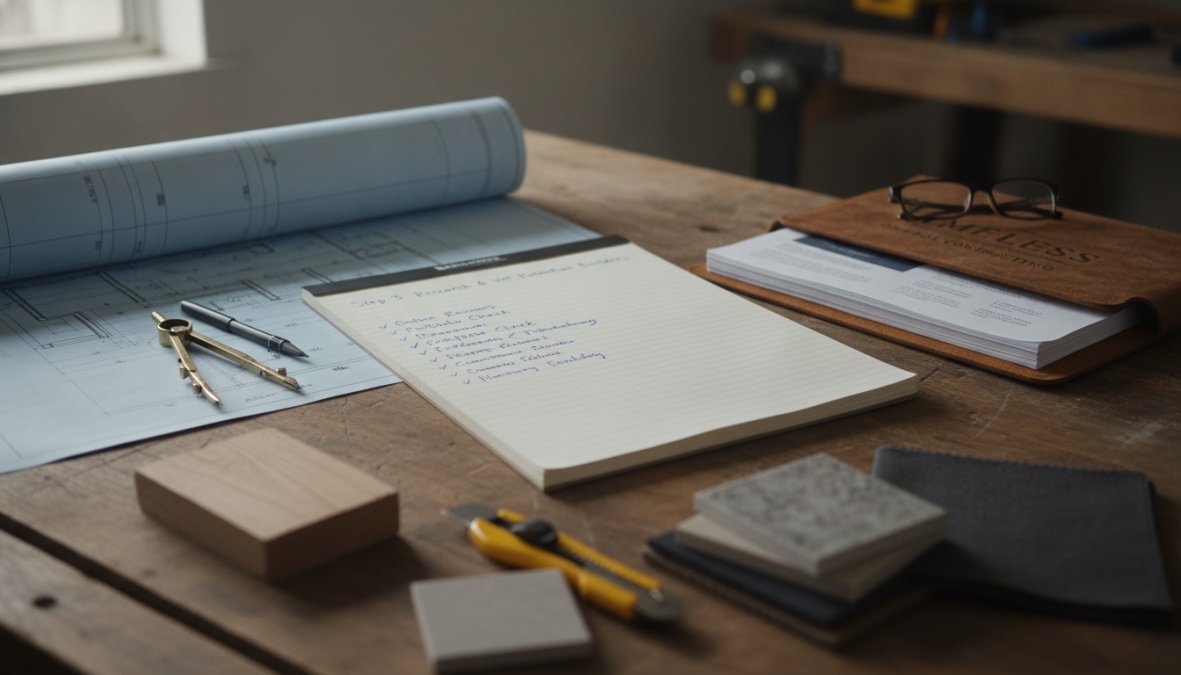
Start by asking for referrals from friends, family, real estate agents, and architects. Ask specifically: "Who did you work with? Would you hire them again? What was the experience like?" Direct referrals carry more weight than online reviews.
Research builders online. Look at their portfolios and the variety of projects they've completed. Do they have experience with your architectural style? Have they built homes in your area or similar climates?
Check credentials carefully. Look for Red Seal certification, which indicates the builder has met rigorous professional standards. Verify licensing through your provincial or local regulatory body. Ask about insurance and bonding.
Verify Credentials and Red Flags to Watch
Before you meet with a builder, run a background check. Search the builder's name plus "complaint," "lawsuit," or "BBB" to see if any public issues surface. A pattern of complaints is a warning signal.
When you meet with potential builders, pay attention to how they communicate. Do they listen to your needs, or do they push their standard approach? Red flags include builders who pressure you to decide quickly, won't provide references, can't explain their process clearly, or seem dismissive of your concerns.
Ask about their subcontractor relationships. Does the builder work with the same subs repeatedly, or do they shop for the lowest bid on each project? Consistent subcontractor relationships usually mean better quality and fewer delays.
Questions to Ask a Custom Home Builder Before Hiring
Before you sign a construction contract, ask these critical questions:
Project Experience & Process:
- How many custom homes have you built in the last three years?
- Can you provide references from three recent clients I can contact?
- Walk me through your typical project timeline from start to finish.
- How do you handle changes and unexpected issues during construction?
Communication & Transparency:
- How will I stay updated on project progress?
- Do you have a project portal or app where I can track progress in real-time?
- Who is my primary point of contact throughout the build?
Budget & Costs:
- Can you provide an itemized cost breakdown, not just a lump sum?
- What contingency do you recommend, and why?
- How do change orders work, and what's your typical markup?
Contracts & Protections:
- What type of contract do you use, fixed-price or cost-plus?
- What warranties do you provide, and for how long?
- How are disputes resolved if we disagree on quality or costs?
Credentials & Insurance:
- Can you provide proof of licensing and insurance?
- Are you Red Seal certified?
- What is your experience with building permits and inspections in this area?
Step 4: Understand the Custom Home Building Process
The custom home building process typically unfolds in five phases: design finalization, site preparation, framing and rough-ins, finish work, and final inspection.
Design finalization happens before construction begins. Your architect or designer creates detailed plans that show every dimension, material specification, and system. Changes to plans after this point become expensive and cause delays.
Site preparation includes clearing the land, grading, establishing utilities, and building access roads. This phase often reveals surprises like unexpected soil conditions or underground obstacles. A good builder budgets for contingencies here.
Framing and rough-ins is when the home takes visible shape. The frame goes up, then electrical, plumbing, and HVAC rough-ins happen before insulation and drywall. This phase typically takes 4-8 weeks.
Finish work includes drywall finishing, painting, flooring, cabinetry, and fixture installation. This phase takes longer than most people expect because there are hundreds of small decisions and coordination points.
Final inspection involves municipal inspections and a walk-through with the builder to identify punch-list items. This final phase typically takes 2-4 weeks.
Site Preparation, Permits, and Timeline Expectations
Site preparation costs and timelines vary dramatically based on lot conditions. A level, cleared lot with utilities nearby might need just 2-4 weeks of prep work. A sloped lot with poor soil or no utilities could take months and cost significantly more.
Ask your builder to walk the lot with you and explain what site preparation will involve. Ask specifically about soil conditions, drainage, utility locations, and any restrictions.
Building permits are required before construction begins. The builder typically handles permit applications, but the timeline depends on your local authority. Some jurisdictions issue permits in 2-3 weeks; others take 8-12 weeks.
Step 5: Compare Builder Quotes and Contracts
Once you've narrowed your choices to 2-3 builders, request detailed quotes. A proper quote should include a detailed breakdown of all costs: site preparation, materials, labor, subcontractors, permits, insurance, contingency, and profit margin.
When comparing quotes, look for consistency in what's included. Create a comparison spreadsheet listing the same line items for each builder so you can see apples-to-apples costs. Pay attention to the contingency amount. A builder who includes a larger contingency is usually being more honest about the risks involved.
Fixed-Price vs. Cost-Plus Contracts and Change Orders
Two main contract types exist for custom homes: fixed-price and cost-plus.
A fixed-price contract locks in a total price. The builder assumes all risk if costs overrun. This works best when your plans are 100% finalized before construction begins.
A cost-plus contract charges you for actual labor and materials plus a markup (typically 10-20%). This is more flexible for changes but requires trust in your builder. Timeless General Contracting uses transparent cost-plus contracting with detailed tracking so you see exactly what you're paying for.
Change orders are inevitable in custom home building. A good change-order process is simple: the builder documents the change, provides a cost impact, you approve it, and work continues.
Custom Home Builder Checklist: Evaluating Your Top Choices
Use this checklist to evaluate your final builder candidates:
| Evaluation Criteria | Builder 1 | Builder 2 | Builder 3 |
|---|---|---|---|
| Red Seal certified | ☐ | ☐ | ☐ |
| Licensed and insured | ☐ | ☐ | ☐ |
| References provided (3+) | ☐ | ☐ | ☐ |
| Portfolio matches your style | ☐ | ☐ | ☐ |
| Local experience (5+ years) | ☐ | ☐ | ☐ |
| Itemized cost breakdown | ☐ | ☐ | ☐ |
| Clear communication style | ☐ | ☐ | ☐ |
| Real-time project tracking | ☐ | ☐ | ☐ |
| Reasonable timeline estimate | ☐ | ☐ | ☐ |
| Responsive to questions | ☐ | ☐ | ☐ |
| No unresolved complaints | ☐ | ☐ | ☐ |
| Warranty clearly explained | ☐ | ☐ | ☐ |
Score each builder by counting checkmarks. This exercise forces you to evaluate consistently across all candidates.
Custom Home Builder Contract: Key Terms and Protections
Before you sign anything, understand what you're committing to. A custom home builder contract is a legal document that defines your relationship, responsibilities, and protections.
Scope of Work: This section lists everything the builder will provide and should reference the architectural plans. If something you expect isn't listed, it won't be included.
Price and Payment Terms: This spells out the total contract price, payment schedule, and what happens if costs change. Typical payment schedules are 10% down, then monthly payments tied to construction milestones, with final payment at completion.
Timeline: The contract should state the start date and estimated completion date, and clarify what delays are the builder's responsibility versus yours.
Change Order Process: This defines how changes are requested, priced, and approved. A good process protects both parties by documenting everything in writing.
Warranty: The builder should warrant all work for a specified period (typically 1-2 years for structural, 5-10 years for major systems).
Warranties, Subcontractors, and Final Inspection Standards
Warranties are your protection after the build is complete. A standard warranty covers defects in workmanship and materials for a set period. Understand what's NOT covered: cosmetic issues, normal wear and tear, and natural settling are typically excluded.
Ask about subcontractor warranties too. If the plumber installs a faulty fixture, does the builder warrant it, or do you deal with the plumber directly? A good builder warrants all subcontractor work as if the builder did it themselves.
The final inspection is your chance to identify punch-list items before you take possession. Walk through the entire home with the builder and create a written list of anything that needs attention.
Choosing a custom home builder ultimately comes down to finding someone who listens, communicates clearly, and has a proven track record of delivering quality on budget and on time. The process takes effort, but it's worth every hour invested. Timeless General Contracting brings 25 years of experience, Red Seal certification, and our innovative Client Project Portal that keeps you informed in real-time throughout your build. When you're ready to move forward with confidence, contact Timeless General Contracting for a consultation and let's bring your vision to life.
Frequently Asked Questions
What questions should I ask a custom home builder before hiring?
Ask about their experience with similar projects, how they handle change orders, their warranty coverage, subcontractor management, and timeline estimates. Request references from past clients and ask about their construction contract terms, specifically whether they use fixed-price or cost-plus pricing. Also inquire about their approach to site preparation, building permits, and how they keep clients informed throughout the custom home building process. Transparency about labor and materials costs is essential.
How do I identify red flags when choosing a custom home builder?
Watch for builders who pressure you into quick decisions, avoid providing itemized breakdowns, lack verifiable credentials or references, or promise unrealistically low estimates. Be cautious of builders unwilling to discuss change orders upfront or who are vague about site conditions and project scope. Red flags also include lack of insurance, poor communication practices, and resistance to detailed architectural plans or specifications. Verify any claimed certifications independently rather than taking them at face value.
What's the difference between a fixed-price contract and a cost-plus contract?
A fixed-price contract locks in total labor and materials costs upfront, protecting you from cost overruns but potentially limiting flexibility. A cost-plus contract charges actual costs plus a percentage markup, offering flexibility for changes but making final costs unpredictable. Fixed-price works best when your project scope is clear and stable; cost-plus suits complex projects where site conditions or design decisions may evolve. Both should include detailed specifications and clear change order procedures to prevent disputes.
How important is a custom home builder's experience and reputation?
Experience is critical, builders with 10+ years handling projects similar to yours understand site preparation challenges, permitting timelines, and value engineering opportunities that less experienced builders miss. Reputation, verified through references and online reviews, indicates their reliability with warranties, final inspections, and communication. A builder's portfolio demonstrates quality and design capability. In competitive markets, experience and reputation justify premium pricing because they reduce costly delays, rework, and scope creep that plague inexperienced builders.
This article was written using GrandRanker