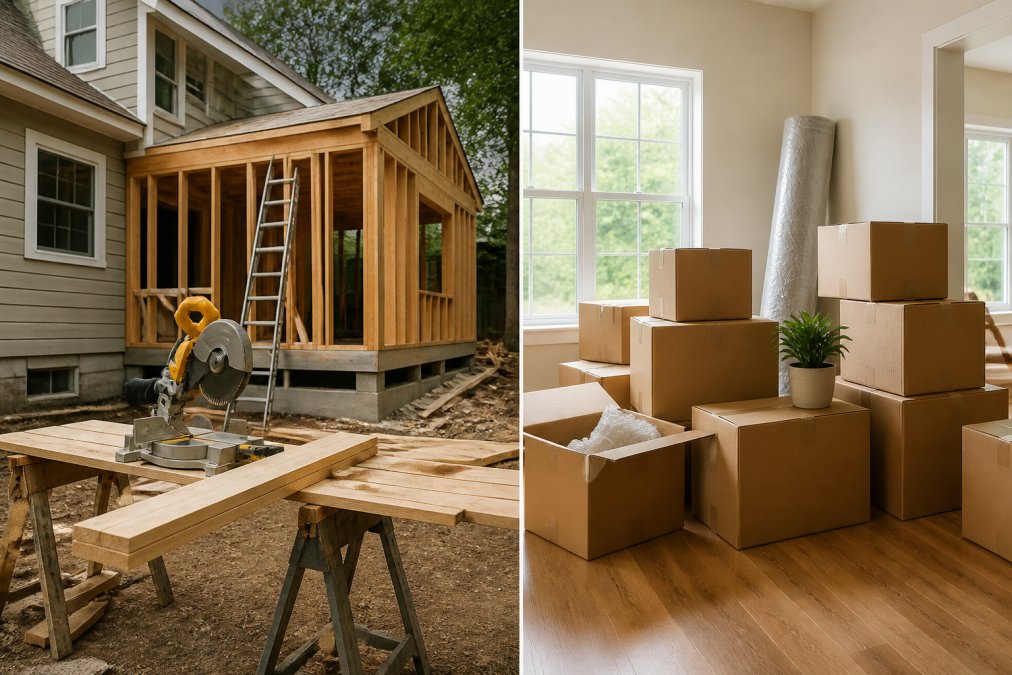
 comparison
Home Addition vs Moving: A 2026 Financial Guide
Table of Contents
- Home Addition vs Moving: Financial Comparison
- Cost of Home Addition Per Square Foot Canada
- Hidden Costs of Moving in Canada
- Zoning Bylaws and Building Permits Canada
- Tax Implications: Capital Gains vs Home Equity
- The Interest Rate Lock-In Effect
- Land Transfer Tax Calculator and Closing Costs
- Disruption, Timeline, and Quality of Life
Last Updated: August 6, 2026
Home Addition vs Moving: Financial Comparison
The decision between a home addition vs moving to a new house is one of the most consequential financial choices a homeowner can make. It hinges on capital allocation, tax implications, interest rates, and lifestyle disruption. At Timeless General Contracting, we combine expert craftsmanship with modern transparency to bring your vision to life, and the answer is rarely obvious on paper.
Three hidden factors shift the entire calculation. First, mortgage interest rates lock you into a specific cost structure that doesn't change when you move. Second, capital gains taxes on your current home can dwarf the savings you think you're making by staying. Third, the disruption of a major renovation has measurable quality-of-life costs that don't show up in spreadsheets.
The financial comparison depends heavily on your current equity, local real estate market conditions, and your timeline. Moving involves closing costs, land transfer tax, real estate commissions, and the hunt for the right property. A home addition requires construction financing, permits, and contractor coordination. Each path has genuine hidden costs that derail most homeowner calculations.
Below, we'll walk you through the financial mechanics of both options, the tax implications that often surprise people, and the disruption factors that determine whether you're making a smart decision or a costly mistake.
Cost of Home Addition Per Square Foot Canada
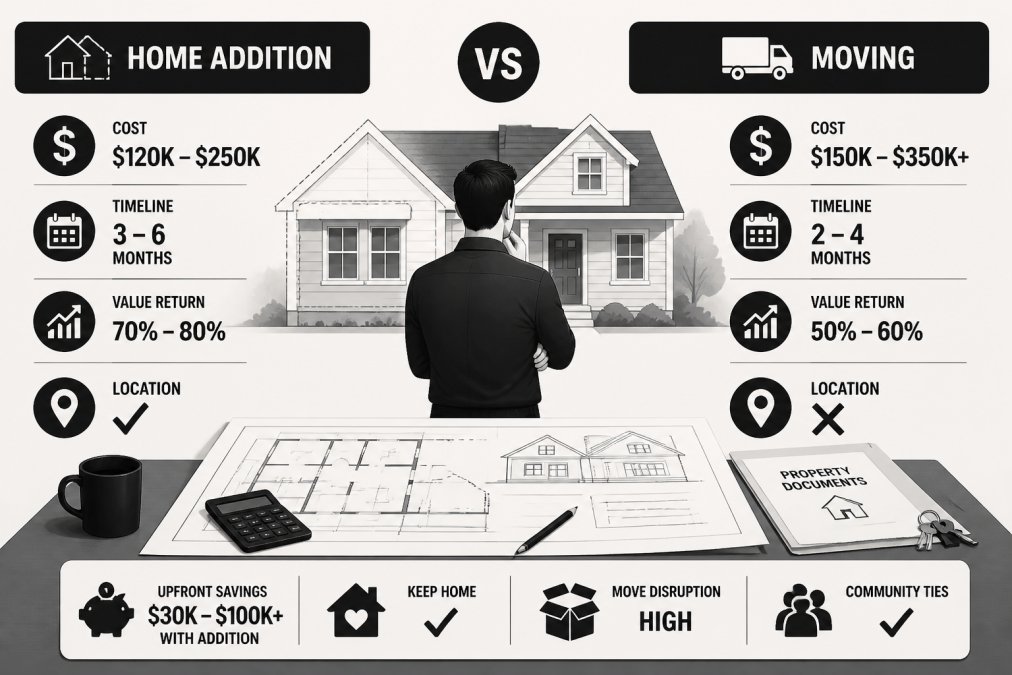
The cost of home addition per square foot Canada varies significantly depending on the scope of work, local labor availability, and material choices. A basic addition with standard drywall, flooring, and lighting costs less per square foot than a high-performance renovation with energy-efficient windows, spray foam insulation, heat recovery ventilation, and premium finishes, a difference of 40-60% on the per-square-foot cost.
Material costs fluctuate with lumber prices, labor availability, and project complexity. Significant structural work, bearing wall modifications, electrical panel upgrades, plumbing extensions, foundation reinforcement, or grading work all raise costs substantially.
Timeless General Contracting specializes in high-performance additions that maintain consistent quality with your existing home while delivering long-term energy savings. For accurate pricing on your specific project, a detailed site assessment determines the true scope of work and realistic timeline.
The real cost comparison isn't just per-square-foot pricing, it's the total cost of the addition versus the total cost of buying a new home in your market. That's where the financial decision becomes clear.
Hidden Costs of Moving in Canada
Hidden costs of moving in Canada often exceed the obvious moving truck expenses by 200-300%. Most homeowners budget for the moving company and forget about the cascade of expenses that follow a purchase.
Land transfer tax is the first shock. In Ontario, this tax can reach 4% of the purchase price on homes over a certain threshold. On a $500,000 home purchase, that's $20,000 in tax before you've moved a single box. Other provinces have different rates; check your provincial rules, as they vary significantly.
Real estate commissions typically run 4-6% split between buyer's and seller's agents. On a $500,000 home, you're paying $20,000-$30,000 in commissions. This is a direct cost that reduces your negotiating power and increases the effective purchase price.
Closing costs include legal fees ($1,500-$2,500), home inspection ($400-$600), appraisal fees ($300-$500), title insurance, and property tax adjustments. These add another $3,000-$5,000 to your total moving costs.
Home inspection and appraisal reveal problems the listing photos didn't show. Budget for unexpected repairs in your first year; the average is $5,000-$15,000 for homes that "passed" inspection.
Property tax reassessment happens when you purchase. Your new property tax bill may be higher than the previous owner's, depending on how long they'd owned the home. This is an ongoing cost increase that affects your monthly budget.
Mortgage refinancing or new mortgage origination fees add $800-$2,000 depending on your lender. Some lenders offer no-fee mortgages, but they typically charge a higher interest rate to offset the cost.
The total hidden cost of moving typically ranges from 8-12% of the purchase price before you've made a single mortgage payment on the new home. That's a significant financial barrier that most homeowners underestimate.
Zoning Bylaws and Building Permits Canada
Zoning bylaws and building permits Canada determine whether your addition is even possible and how much it will cost to make it legal. Zoning restrictions control how much of your lot you can build on. Setback requirements specify how far your addition must be from property lines. Height restrictions limit how tall your addition can be. Some neighborhoods have heritage designations that require architectural approval for any external changes.
Building permits are mandatory for any structural work, electrical changes, plumbing additions, or HVAC modifications. Unpermitted work creates liability, complicates insurance claims, and creates problems when you sell. The permit process typically takes 2-8 weeks depending on your municipality and project complexity.
Permit costs vary by municipality but typically range from 0.5-1.5% of the project cost or a flat fee. A $100,000 addition might cost $500-$1,500 in permit fees alone, plus engineering and architectural drawings if required.
Some municipalities require third-party inspections during construction: foundation, framing, mechanical, and final inspection. These inspections ensure the work meets code and add 4-12 weeks to your timeline depending on inspector availability.
Variance applications are required if your addition doesn't meet zoning requirements. A variance allows you to build outside the standard rules but requires municipal approval and often involves a public hearing. Variance applications cost $500-$2,000 and add 8-16 weeks to your timeline.
Understanding your local zoning and permit requirements before you commit to an addition design can save months and thousands of dollars. Timeless General Contracting has 25 years navigating Pictou County's specific zoning and permitting landscape, which translates to faster approvals and fewer costly redesigns.
Tax Implications: Capital Gains vs Home Equity
The tax treatment of your home addition versus the sale of your current home is where most homeowners make expensive mistakes.
Capital gains tax applies when you sell your principal residence. In Canada, 50% of the capital gain is taxable. If you've owned your home for 20 years and it's appreciated by $300,000, you owe tax on $150,000 of that gain. At a 50% marginal tax rate, that's $75,000 in tax liability.
When you add an addition to your home, you're increasing the adjusted cost basis of your property. If you spend $150,000 on an addition and it adds $200,000 to your home's value, you've created $50,000 in taxable capital gain that wouldn't have existed if you'd simply moved.
Home equity built through an addition stays in your home until you sell. You can access it through a home equity line of credit (HELOC) if you need liquidity, but you don't realize the value until you sell. This is an advantage if you're planning to age in place.
When you move to a new home, you're starting fresh on the capital gains calculation. Your new home's purchase price becomes the new cost basis. You're not carrying forward the capital gains from your previous home; you've crystallized them and paid the tax.
The strategic question is timing. If your current home has significant unrealized gains and you're in a high tax bracket, staying and adding might defer a large tax bill. If you're planning to downsize or move to a lower-cost market, selling now might make sense despite the immediate tax hit.
Consult a tax professional before making this decision. The difference between the wrong and right choice can easily be $30,000-$100,000 depending on your situation.
The Interest Rate Lock-In Effect
When you took out your current mortgage, you locked in an interest rate. If you secured a 3.5% five-year fixed rate three years ago, you have two years remaining at that rate. The current mortgage market might be offering 5.2% for new mortgages. This is the interest rate lock-in effect, your existing mortgage is a valuable asset that moving would force you to abandon.
If you move, you must pay off your existing mortgage and take out a new one at current market rates. On a $400,000 mortgage, the difference between 3.5% and 5.2% is roughly $6,800 per year in additional interest costs. Over the remaining amortization period, that compounds into a significant financial burden.
If you stay and add, you keep your low-rate mortgage and potentially use a home equity line of credit for the addition. A HELOC typically carries a variable rate that's lower than a new mortgage but higher than your locked-in rate. The financial advantage of keeping your existing mortgage can easily justify staying even if the new home would otherwise be appealing.
This effect is often invisible in typical decision-making frameworks, but it can swing the entire calculation by $50,000-$150,000 depending on your mortgage balance, remaining term, and current rate environment.
Land Transfer Tax Calculator and Closing Costs
Understanding your actual closing costs requires a detailed calculation specific to your situation.
Land transfer tax in Canada varies by province. Ontario charges on a sliding scale: 0.5% on the first $55,000, 1% on the next $95,000, 1.5% on the next $85,000, and 2% on amounts over $235,000. For a $500,000 purchase, the Ontario land transfer tax is approximately $6,475. Other provinces have different structures; some charge flat percentages, others have exemptions for first-time buyers.
Real estate commission is typically 4-6% of the sale price, split between buyer's agent and seller's agent. On a $500,000 transaction, expect $20,000-$30,000 in commission.
Legal fees for the purchase transaction typically range from $1,500-$2,500. Your lawyer handles title search, title insurance, document preparation, and closing coordination.
Home inspection costs $400-$600 and is typically paid upfront. Home appraisal costs $300-$500 and is ordered by your lender.
Title insurance protects you against claims against the property's title. Costs range from $200-$500 depending on the purchase price and your insurer.
Property tax adjustment happens at closing. If the seller has prepaid property taxes, you reimburse them for the portion of the year you own the property.
Mortgage origination fees vary by lender. Some charge $800-$2,000; others offer no-fee mortgages with a slightly higher interest rate.
| Cost Category | Typical Range | Notes |
|---|---|---|
| Land Transfer Tax (ON) | $3,000-$12,000 | Varies by province and purchase price |
| Real Estate Commission | $20,000-$30,000 | 4-6% of purchase price |
| Legal Fees | $1,500-$2,500 | Title search, insurance, documents |
| Home Inspection | $400-$600 | Recommended for all purchases |
| Home Appraisal | $300-$500 | Ordered by lender |
| Title Insurance | $200-$500 | Protects against title claims |
| Mortgage Fees | $800-$2,000 | Varies by lender and product |
| Total Estimated | $26,200-$48,100 | Plus property tax adjustments |
The total closing cost of moving typically represents 5-8% of the purchase price, a significant expense that must be factored into the financial comparison.
Disruption, Timeline, and Quality of Life
The financial comparison between moving and adding often ignores the human cost of disruption, but this factor frequently determines the actual outcome.
A major home addition typically takes 4-8 months from permit approval to completion. During this time, your home is an active construction site with dust, noise, contractor access needs, parking difficulties, and potentially offline kitchen or bathrooms. Families with young children or elderly relatives experience genuine stress during renovation.
The disruption isn't linear. The first month involves site preparation and foundation work with minimal impact. Months two through five involve framing, electrical, plumbing, and mechanical work with maximum disruption. Months six through eight involve finishing, painting, and final inspections with moderate disruption.
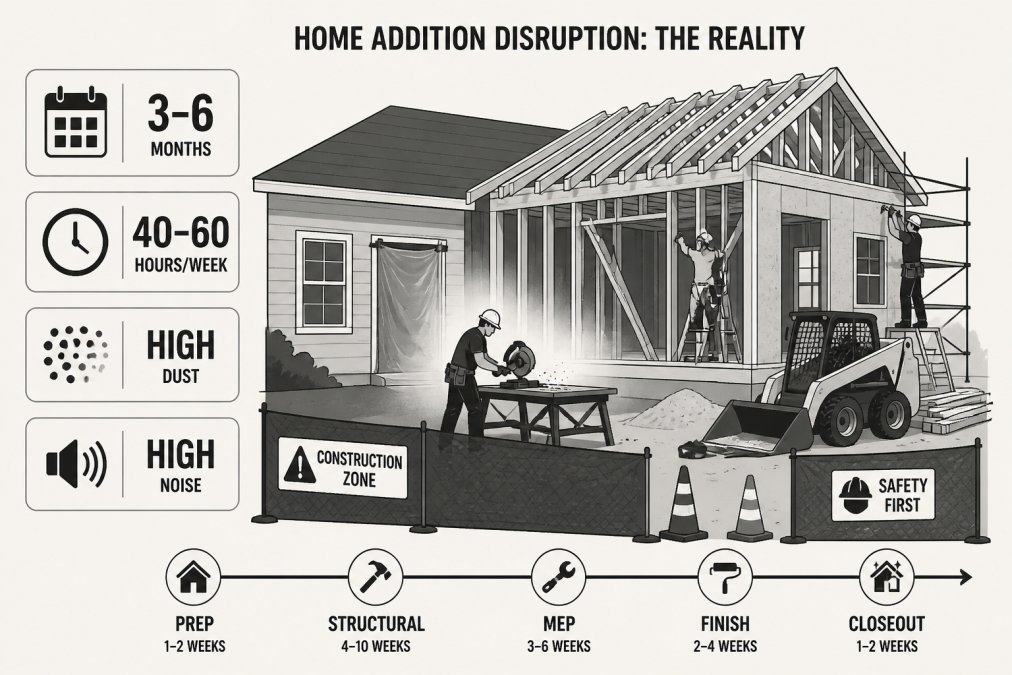
Moving takes 4-12 weeks from offer acceptance to closing, plus 2-4 weeks for physical relocation and settlement. The disruption is concentrated but intense. After that, the disruption ends. You're settled in your new home with no ongoing construction.
Quality of life during renovation affects your work productivity, family relationships, and mental health. Families report higher stress levels during major renovations. Timeless General Contracting minimizes disruption through the Client Project Portal, which provides real-time updates on progress, schedule, and any issues that arise. Transparent communication reduces the anxiety that often accompanies renovation projects.
The decision between moving and adding should factor in your tolerance for disruption. If you have young children, aging parents in your home, or work that requires focus and quiet, the disruption cost of a major addition is higher than the financial spreadsheet suggests. For many homeowners, the quality-of-life benefit of moving to a home that's already finished often outweighs the financial advantages of staying and adding.
The decision between a home addition vs moving ultimately depends on your financial situation, tax circumstances, interest rate environment, and personal tolerance for disruption. The spreadsheet analysis matters, but it's only part of the story. The hidden costs of moving, the capital gains tax implications, and the interest rate lock-in effect often shift the calculation in unexpected directions.
If you're planning a major addition in Pictou County, Timeless General Contracting can provide a detailed cost estimate and timeline that helps you make this decision with confidence. Our 25 years of experience and Red Seal certification mean you're working with professionals who understand both the construction side and the financial implications. The Client Project Portal keeps you informed every step of the way. Get started with Timeless General Contracting and make an informed choice about your home's future.
Frequently Asked Questions
What are the hidden costs of moving in Canada that most people forget about?
Beyond the moving company fee, budget for land transfer tax (varies by province, typically 1-4% of purchase price), real estate commission (usually 4-6%), home inspection ($300-600), appraisal fees ($250-400), legal fees ($800-1,500), and title insurance. In Nova Scotia, land transfer tax ranges from 1-3% depending on purchase price. Many homeowners underestimate closing costs, which can total 3-5% of the purchase price. Factor in temporary accommodation, utility setup fees, and address changes across financial institutions.
How much does a home addition cost per square foot in Canada?
Home addition costs in Canada typically range from $150-$300+ per square foot, depending on finishes, structural complexity, and regional labor rates. Pictou County costs may differ from major urban centers. A second story or structural addition costs more than a single-story extension. High-performance energy-efficient additions command premium pricing. Costs include foundation work, framing, electrical, plumbing, HVAC, insulation, and finishes. Get detailed contractor estimates for your specific project, as site constraints, zoning requirements, and architectural design significantly impact final costs.
Does a home addition increase property value in Canada?
A well-executed home addition typically adds 50-80% of its cost back to property value, depending on market conditions, neighborhood desirability, and addition quality. Additions that improve functionality (extra bedroom, expanded kitchen) return more value than cosmetic upgrades. However, market appreciation, current mortgage interest rates, and local housing demand affect resale value more than the addition itself. In a rising market, you may recover most costs; in a flat market, you may not break even immediately. The real benefit is living in a home that meets your needs now, rather than relying on future resale gains.
What are the tax implications of selling my home versus renovating it in Canada?
Your principal residence is exempt from capital gains tax in Canada, so selling doesn't trigger tax on appreciation. However, moving costs (realtor commission, legal fees, land transfer tax) reduce your net proceeds. Renovations funded through a home equity line of credit generate no immediate tax, but interest is not deductible for personal use. If you rent out the renovated space, you may claim renovation costs as capital improvements. Consult a tax professional, as individual circumstances vary. The key difference: moving triggers immediate transaction costs; renovations spread costs over time and keep you in a familiar community.
How do zoning bylaws and building permits affect my decision to add versus move?
Zoning bylaws in your municipality determine what additions are permitted. Some areas restrict building height, setback distances, lot coverage, or property footprint expansion. Permits are required for most structural work and can cost $500-$2,000 depending on project scope. Permit delays can extend timelines by weeks or months. Before committing to an addition, verify with your local planning department whether your project is feasible under current bylaws. Moving avoids zoning constraints but requires finding a property that already meets your needs. In Pictou County, regulations vary by community, so early consultation with municipal planning staff is essential.
This article was written using GrandRanker