 comparison
Custom Home vs Production Home: Pros, Cons & Costs
Table of Contents
- Custom Home vs Production Home: Key Differences
- Cost to Build a Custom Home in Canada
- Production Home Construction Timeline
- Design Flexibility and Customization Options
- Tarion Warranty Coverage for Custom vs Production Homes
- Pros and Cons: Custom Homes
- Pros and Cons: Production Homes
- Making Your Decision: Custom or Production Home
Last Updated: August 7, 2026
Custom Home vs Production Home: Key Differences
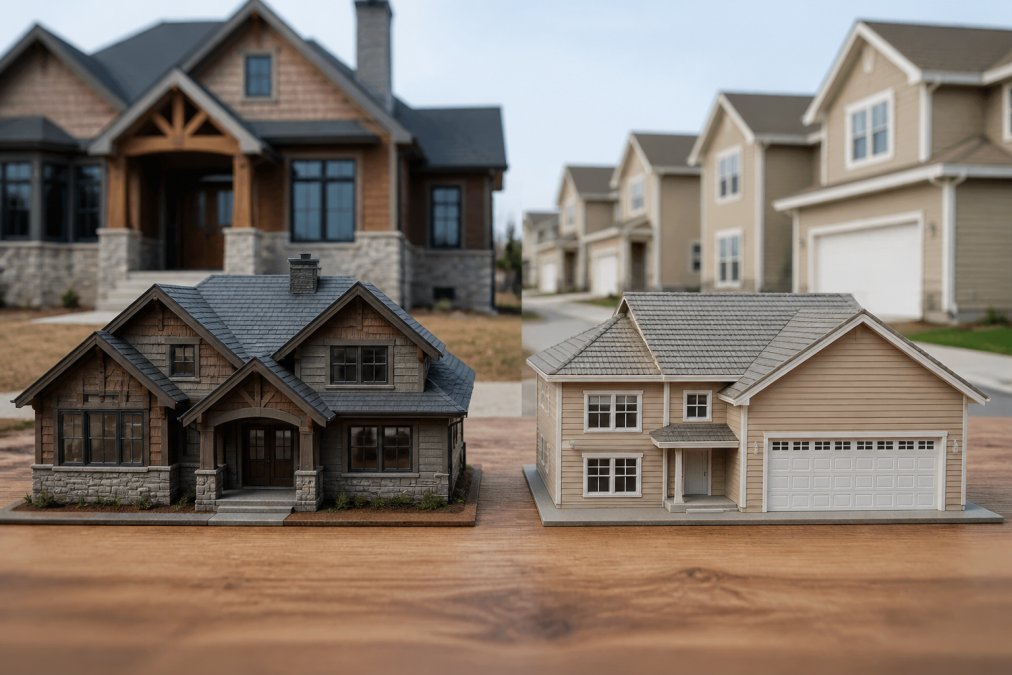
A custom home is built specifically for you on your chosen land, designed from the ground up to match your preferences, while a production home is constructed from pre-designed floor plans in planned communities. The fundamental difference lies in control versus convenience. With a custom home, you're directing nearly every decision from foundation to final paint color. With a production home, you're selecting from predetermined options, which simplifies the process but limits customization.
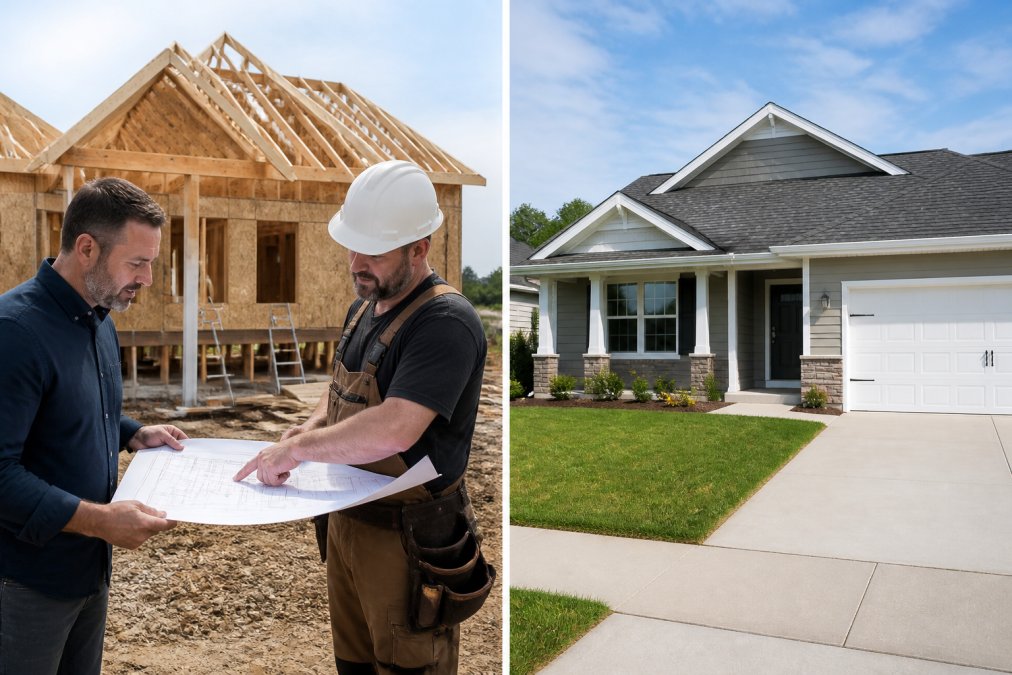
At Timeless General Contracting, we've worked with homeowners across both paths. The decision comes down to your priorities: if you want a home reflecting your exact vision and can manage complexity, custom building makes sense. If you value speed, predictability, and simplicity, production homes offer clear advantages.
Cost to Build a Custom Home in Canada
Building a custom home involves land acquisition, design services, permits, construction labor, materials, and contingencies. Land purchase often represents 15-30% of your total project cost. Design and architectural services typically run 5-10% of construction costs. Building permits vary by province but can range from several hundred to several thousand dollars.
Many homeowners underestimate hidden costs: site preparation, utility connections to remote properties, structural upgrades to meet building codes, and change orders during construction can add 5-15% to projects.
For financing, the CMHC Improvement mortgage insurance program supports new construction with flexible advancing options, allowing you to draw funds as construction progresses rather than paying upfront.
Production homes offer transparent, fixed pricing. You know the total cost before construction begins, though you're paying for whatever the builder includes, whether you need it or not.
Production Home Construction Timeline
Production homes follow predictable schedules because builders work from proven processes and standardized designs. Most take 4-6 months from foundation to move-in. Site preparation and foundation require 4-6 weeks. Framing takes 6-8 weeks. Mechanical, electrical, and plumbing installation follows in 4-6 weeks. Interior finishing spans 6-8 weeks. Final inspections and closing happen in 2-4 weeks.
This compressed timeline exists because production builders optimize processes, order materials in bulk, and employ crews trained on the same floor plans repeatedly. However, weather delays, supply chain disruptions, or inspection failures can extend schedules.
Custom home timelines are longer and less predictable. Design takes 2-4 months. Permit approval requires 4-8 weeks. Construction typically spans 8-14 months. Total time from concept to move-in often reaches 18-24 months, reflecting the nature of specialized work and decision-making required.
Design Flexibility and Customization Options
With a custom home, design options are limited only by budget, building codes, and site constraints. You specify floor plan layout, room dimensions, ceiling heights, material selections, architectural style, and finishes. This appeals to homeowners with specific accessibility needs or unusual preferences.
However, unlimited customization creates decision fatigue. You'll make hundreds of choices from flooring to door hardware. Many custom homeowners report the decision-making process becomes exhausting by final phases.
Production homes eliminate this fatigue by offering limited but curated choices. You typically select from 3-5 floor plans, then choose from predetermined upgrade packages. Interior finishes come in 2-4 color schemes. This constraint benefits many buyers: choices are vetted, combinations work together aesthetically, and you move through decisions quickly.
Some production builders offer semi-custom options, allowing minor modifications to standard floor plans. This middle ground provides more flexibility than standard production homes but costs less and takes less time than full custom construction.
Tarion Warranty Coverage for Custom vs Production Homes
In Ontario, the Tarion Warranty Corporation provides mandatory new home protection for homes built by registered builders. Tarion covers homes with comprehensive warranty protection including deposit protection up to $60,000 for freehold homes priced at $600,000 or less, one year for defects in workmanship and materials, two years for major systems, and seven years for structural defects.
For custom homes built by a Tarion-registered builder, this protection applies fully. Production homes from registered builders receive identical Tarion coverage. The warranty terms don't change based on build type; the builder's registration status determines coverage.
However, if you act as your own builder (owner-built homes), Tarion coverage does not apply. Many homeowners hire a general contractor specifically to maintain Tarion eligibility and ensure warranty protection.
Outside Ontario, warranty coverage varies by province. Verify what protection applies in your province before committing to either custom or production construction.
Pros and Cons: Custom Homes
Pros of Custom Homes:
Complete design control means your home reflects your vision, not a builder's template. This matters for homeowners with specific accessibility needs or unusual preferences. Long-term satisfaction often runs higher because you've made deliberate choices about every element. Potential resale value can be higher with thoughtful design and quality materials. Energy efficiency and sustainability are easier to prioritize when you specify high-performance insulation, efficient HVAC systems, and sustainable materials from the start.
Cons of Custom Homes:
Cost unpredictability is real. Change orders, unexpected site conditions, permit delays, and material price increases all add expense. Timeline uncertainty creates stress; custom builds take longer and face more delays than production homes. Decision fatigue exhausts many homeowners through hundreds of choices. Contractor dependency is high; your experience depends entirely on your contractor's competence and integrity. Resale risk exists if your custom choices don't appeal to future buyers.
Pros and Cons: Production Homes
Pros of Production Homes:
Predictable pricing and timelines are standout advantages. You know the total cost and expected move-in date before construction begins. The simplified process reduces stress; the builder handles construction decisions while you make limited choices. Move-in ready homes eliminate post-purchase work. Warranty coverage is standard through registered builders. Community amenities often accompany developments, including parks, playgrounds, and walking paths.
Cons of Production Homes:
Limited customization restricts your ability to create a personal home. Standardized designs mean less uniqueness; your home looks similar to others in the development. Potential resale challenges emerge if the market shifts or the development becomes less desirable. Limited design input means you're living with choices you didn't make. Quality variability can occur in some production communities; inspecting completed homes before purchasing helps assess quality.
Making Your Decision: Custom or Production Home
Choosing between custom and production homes requires honest assessment of your priorities, timeline, budget, and tolerance for complexity.
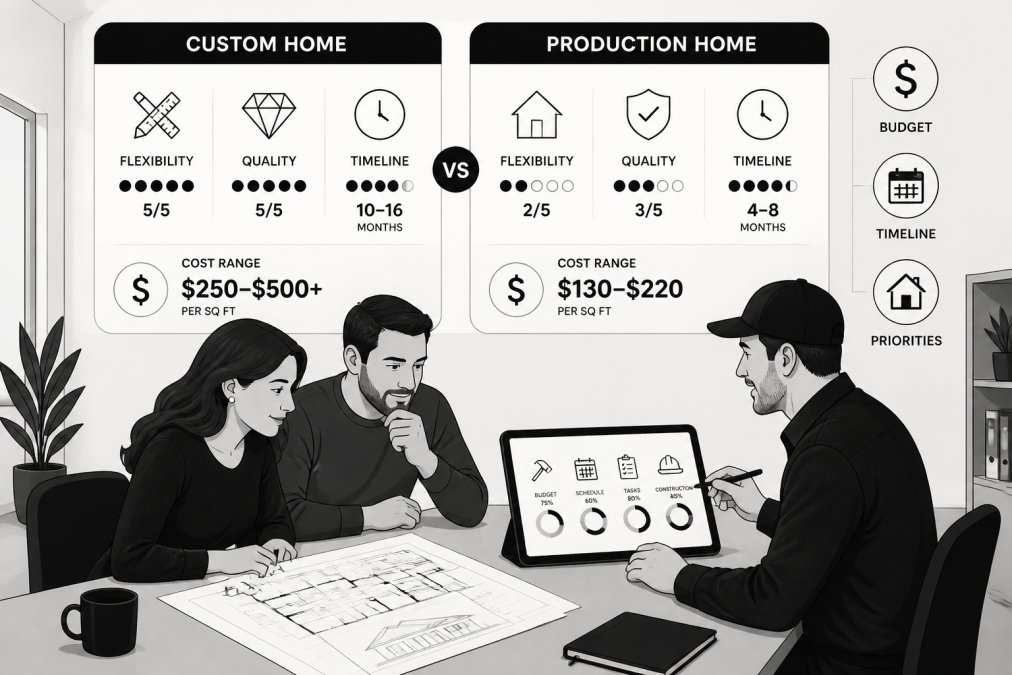
Choose custom if you have specific design requirements that production homes don't meet or need particular accessibility features. Choose custom if you're willing to manage complexity and make numerous decisions. Choose custom if timeline flexibility works for you.
Choose production if predictability matters most and you need to know exact costs and move-in dates. Choose production if you want a simplified process with minimal involvement. Choose production if you're relocating to an unfamiliar area and want to avoid managing a custom build with unknown contractors.
Consider your risk tolerance. Custom homes require trusting your contractor completely. Production homes reduce dependency on a single builder relationship, though standardized processes mean less can go wrong.
Timeless General Contracting has guided homeowners through both paths. For custom builds, our 25 years of experience and Red Seal certification mean you're working with a contractor who understands complexity. Our Client Project Portal keeps you informed in real-time, addressing the biggest frustration homeowners face: lack of visibility into their project.
The decision between custom and production homes reflects your priorities and circumstances. Custom homes deliver complete design control and the satisfaction of building exactly what you envision, but demand your time, decision-making energy, and tolerance for unpredictability. Production homes offer certainty, speed, and simplicity, but require accepting predetermined designs and limited customization. Both paths lead to homeownership; the question is which journey aligns with your life. For custom builds in Pictou County, Timeless General Contracting brings 25 years of Red Seal certified expertise and transparent real-time project tracking through our Client Project Portal, ensuring you stay informed and confident throughout your build.
Frequently Asked Questions
What is the main difference between a custom home and a production home in Canada?
A custom home is designed and built specifically for you, allowing control over floor plan, materials, finishes, and site-specific features. A production home is built from standardized designs by a developer, with limited customization options. Custom homes take longer and cost more upfront, but offer design flexibility and potential long-term value. Production homes are move-in ready faster and have predictable costs, making them ideal for buyers who want a turnkey home without extensive project management.
Are custom-built houses significantly more expensive than production homes?
Yes, custom homes typically cost more per square foot due to site-specific construction, specialized materials, architectural design, and extended timelines. However, total cost depends on location, square footage, and finish selections. Production homes offer lower upfront pricing and fixed costs, but custom homes may command higher resale value if built with quality materials and timeless design. Financing options like CMHC Improvement can help manage construction loan costs for custom builds across Canada.
How long does it take to build a custom home compared to a production home?
Production homes typically take 4-6 months from start to move-in, with standardized layouts and materials reducing construction delays. Custom homes usually require 12-18 months or longer, depending on design complexity, building permits, zoning regulations, and site conditions. Custom builds involve more homeowner involvement in finish selection and design decisions, which extends the timeline. Production homes are designed for speed and efficiency, making them ideal if you need a home quickly.
What does Tarion warranty coverage include for custom vs production homes?
Tarion Warranty Corporation (in Ontario) provides mandatory coverage for new homes built by registered builders, including both custom and production homes. Coverage includes 1-year protection for workmanship defects, 2-year coverage for major systems like plumbing and electrical, and 7-year structural warranty. Custom homes built by registered contractors receive the same Tarion protection as production homes. However, owner-built custom homes do not qualify for Tarion coverage, so choosing a registered builder protects your investment.
Do production homes offer any customization options?
Yes, many production home builders offer semi-custom options, allowing you to select from pre-approved floor plans, exterior finishes, and interior upgrades within a standardized framework. Customization is limited compared to fully custom builds, but you can often modify kitchen layouts, flooring, paint colors, and appliances. These selections must be made early in the construction timeline and within the builder's approved options. This middle ground provides some personalization while maintaining the faster construction timeline and predictable costs of production homes.
This article was written using GrandRanker