 ultimate-guide
Modern Home Renovation Project Management: A 2026 Guide
Table of Contents
- Why Modern Home Renovation Project Management Matters
- Defining Your Scope of Work and Project Lifecycle
- Home Renovation Project Management Software and Digital Tools
- Renovation Budget Tracking Template and Cost Management
- Home Renovation Timeline Checklist and Scheduling
- How to Manage Renovation Contractors Effectively
- Psychological Management and Homeowner Communication
- Post-Renovation Handover and Project Documentation
Last Updated: July 6, 2026
Why Modern Home Renovation Project Management Matters
Managing a home renovation requires intentional project management from day one. A poorly managed renovation can balloon 30-50% over budget, stretch months beyond schedule, and leave quality issues that persist for years. This guide covers modern strategies that work: defining scope clearly, tracking budgets in real time, coordinating contractors effectively, and maintaining sanity throughout.
Defining Your Scope of Work and Project Lifecycle
Your scope of work is the foundation of everything that follows. Instead of "update the kitchen," write: "Remove existing cabinets, countertops, and backsplash. Install new 42-inch maple cabinets with soft-close hinges, quartz countertops, subway tile backsplash, and new under-cabinet lighting." Specific beats vague every time.
Your scope document should include three sections: what's included, what's explicitly NOT included, and what's undecided. This prevents contractors from assuming responsibility for items you haven't decided on.
Creating a Detailed Scope Document
Specify materials by brand and model number, finishes, colors, and installation standards. Include dimensions and locations for every element. "Paint the master bedroom" is vague; "Paint master bedroom walls (12 x 14 feet) in Benjamin Moore Chantilly Lace, satin finish; trim in Benjamin Moore Simply White, semi-gloss" removes ambiguity. Attach floor plans with measurements, electrical outlet locations, and fixture placements.
Have each contractor sign off on the scope before work begins. This ensures everyone understands the same expectations.
Understanding Critical Path and Milestones
The critical path is the sequence of tasks that determines your project's overall timeline. You can't install flooring before walls are framed. Identify these dependencies to keep timelines realistic.
Break your renovation into phases: demolition, structural work, rough-ins (electrical, plumbing, HVAC), drywall, finishes, and final inspections. Set milestones at the end of each major phase as checkpoints for quality and budget review.
:::pro Always include a quality checkpoint before moving to the next phase. A punch list review prevents small issues from compounding into bigger problems later. :::
Home Renovation Project Management Software and Digital Tools
Digital tools have transformed project management. Real-time platforms let you see exactly where your project stands at any moment, centralizing communication, budgets, timelines, and photo documentation.
Real-Time Tracking and Client Portals
A client portal eliminates the information gap between contractors and homeowners. Log in to see photos from that day, updated task completion status, and site notes. Real-time tracking also catches problems early, if work doesn't match your scope, you address it immediately rather than discovering it during final inspection.
Look for platforms that let you upload photos tagged by location and date, create and track punch lists, store contracts and permits in one place, and communicate directly with contractors.
Gantt Charts and Timeline Visualization
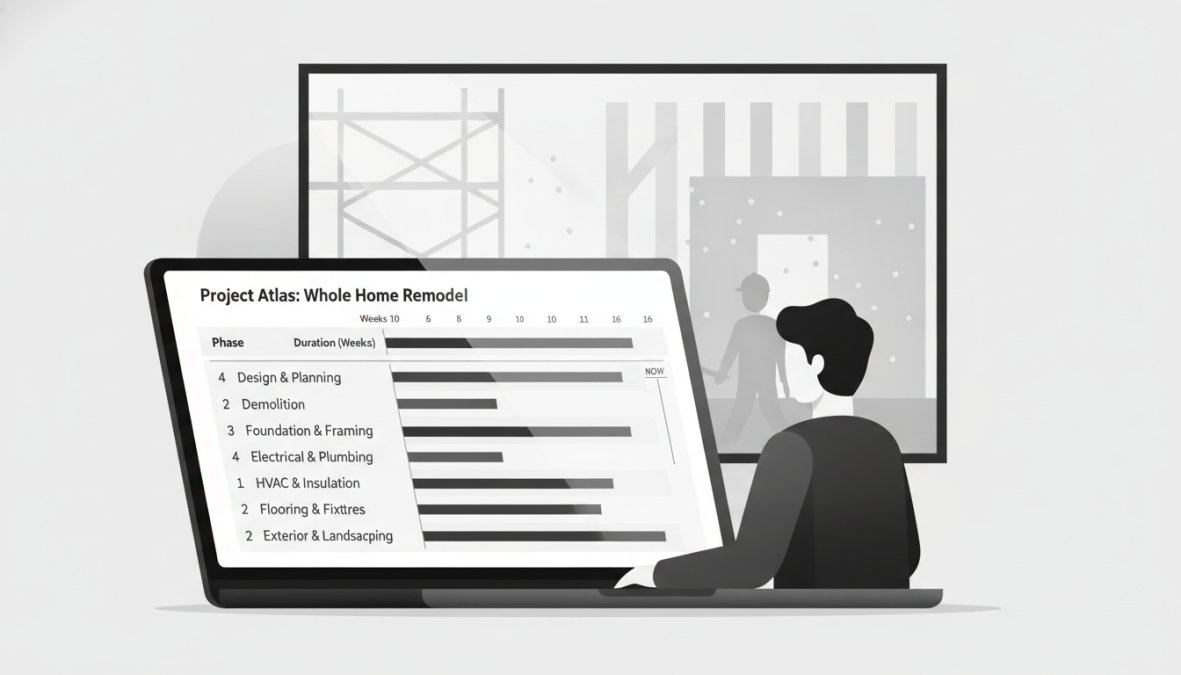
A Gantt chart displays your project timeline visually, showing which tasks happen in parallel and which must happen sequentially. When a task falls behind, the chart highlights it immediately so you understand the impact on your overall timeline. Share the chart with contractors so everyone understands how their work fits into the larger sequence.
Renovation Budget Tracking Template and Cost Management
Start with a line-item budget that breaks your project into categories: demolition, framing, electrical, plumbing, HVAC, drywall, painting, flooring, fixtures, and finishes. For each category, estimate the cost and track actual spending as invoices arrive. Update it weekly to catch overspending patterns early.
Setting Contingency Funds and Change Orders
Set aside 10-15% of your total budget as contingency for unexpected discoveries. For a $100,000 renovation, that's $10,000-$15,000. When something unexpected arises, get a change order before work begins, a written agreement specifying what additional work will be done, what it costs, and how it affects the timeline.
| Budget Element | Estimated | Actual | Variance | Status |
|---|---|---|---|---|
| Demolition | $8,000 | $8,200 | +$200 | On track |
| Framing/Structural | $12,000 | $12,500 | +$500 | Minor overrun |
| Electrical rough-in | $6,000 | $6,100 | +$100 | On track |
| Plumbing rough-in | $7,000 | $7,300 | +$300 | Minor overrun |
| HVAC installation | $5,000 | $5,000 | $0 | On track |
| Drywall/tape/mud | $4,500 | $4,650 | +$150 | On track |
| Painting | $3,500 | $3,400 | -$100 | Under budget |
| Flooring | $9,000 | $9,200 | +$200 | On track |
| Fixtures/finishes | $8,000 | $8,150 | +$150 | On track |
| Subtotal | $63,000 | $64,500 | +$1,500 | 2.4% over |
| Contingency (10%) | $6,300 | $1,800 remaining | , | , |
Procurement and Resource Allocation
Create a procurement schedule that works backward from your critical path. Identify which materials have the longest lead times and order them first. Cabinets, custom doors, and specialty fixtures often have 8-16 week lead times.
Resource allocation means scheduling contractors efficiently so one trade finishes as the next arrives. The drywall crew needs to arrive after electrical and plumbing rough-ins are complete and inspected. Map these dependencies on your Gantt chart.
Home Renovation Timeline Checklist and Scheduling
A timeline checklist keeps you organized: pre-renovation tasks (finalizing designs, getting permits, hiring contractors, ordering materials), phase-by-phase tasks (demolition, structural work, rough-ins, inspections, drywall), and post-renovation tasks.
Building Permits and Legal Requirements
Building permits require a professional inspector to verify that work meets current building code. The permit process typically takes 1-4 weeks depending on your jurisdiction. Budget this time into your timeline.
Inspections happen at specific milestones: after framing, after electrical rough-in, after plumbing rough-in, after HVAC installation, and before final occupancy. Budget extra time for potential re-inspections if work doesn't pass.
Coordinating HVAC, Electrical, and Plumbing Phases
Plumbing rough-in typically happens first because water lines have less routing flexibility. Electrical rough-in happens next because wires can be rerouted more easily. HVAC rough-in happens last because ductwork is most flexible.
Before any rough-in work starts, have all three trades walk the space together and agree on routing. A 15-minute coordination meeting prevents hours of rework later.
How to Manage Renovation Contractors Effectively
Managing contractors is about being clear. Start with contractor selection: get multiple bids, but don't choose based on price alone. The cheapest bid often means the contractor is underbidding and will cut corners or hit you with change orders later. Look for licensed, insured contractors with solid references from similar projects.
Interview contractors before hiring. Ask about their process, timeline, how they handle changes, and communication approach.
Contractor Vetting and Communication Strategies
Vet contractors by checking references and credentials. Call at least three recent clients and ask: Did they start and finish on time? Did costs stay within budget? Was communication responsive? Verify licensing and insurance before signing a contract.
Establish a communication protocol upfront: How often will you get updates? Who do you contact with questions? How quickly do you expect responses? Use your project management portal for all communication to create a written record.
Quality Assurance and Punch List Management
Inspect work as it progresses, not waiting until the end. After each phase, walk the space and verify that work matches your scope. Create a punch list before final payment, a detailed list of incomplete or substandard work. Be specific: "Outlet in master bedroom is 18 inches from corner instead of 12 inches as specified."
The punch list should be completed before final payment, giving you leverage to ensure work meets your standards.
Psychological Management and Homeowner Communication
Renovations are stressful. Expect the work to be messier, louder, and longer than imagined. Set realistic expectations with your family: work happens during business hours, dust and debris are part of the process, and unexpected conditions will arise.
Stay engaged without micromanaging. Check in regularly and understand what's happening, but trust contractors to do their work. Maintain perspective: the renovation is temporary disruption for long-term improvement.
Communication with your household matters as much as communication with contractors. If family members work from home, agree on quiet hours. If you have young children, establish safe zones away from the work area.
Post-Renovation Handover and Project Documentation
The renovation isn't complete when the last contractor leaves. Request a final walkthrough to verify everything is finished. Test all fixtures, switches, and appliances. Turn on the HVAC and verify temperature control.
Document everything with photos and videos. Photograph every room, fixture, and finish as reference for the original condition. Collect all warranties, manuals, and maintenance instructions from contractors and store them in one place.
Request a project summary document listing all work completed, materials used, contractors involved, and permits obtained. Conduct a final budget reconciliation to understand where you spent more or less than expected.
Managing a home renovation successfully requires clear planning, real-time tracking, and strong communication. Defining scope precisely, tracking budgets weekly, coordinating contractors intentionally, and documenting everything prevent the chaos that derails most renovations. These frameworks transform your renovation from a source of stress into a manageable, successful project that delivers the home you envisioned.
Frequently Asked Questions
What is the best software for home renovation project management?
The best software depends on your project complexity and budget. Modern home renovation project management tools like Buildertrend and Houzz offer real-time tracking, Gantt charts, and budget management. Look for platforms that provide a client portal for transparency, automated change order tracking, and integration with contractor communication. Red Seal-certified professionals often recommend tools with strong documentation and milestone tracking capabilities for high-performance renovations.
How do I keep track of renovation costs and timelines?
Use a renovation budget tracking template that includes line items for all major phases: permits, structural work, HVAC, electrical rough-in, plumbing fixtures, and finishes. Track actual costs against estimates weekly. For timelines, create a Gantt chart identifying the critical path, tasks that directly impact your completion date. Set milestones for permit approvals, inspections, and major phase completions. Digital tools automate this tracking and alert you to budget overruns or schedule delays immediately.
How do you manage a home renovation project yourself?
Start by defining a detailed scope of work and breaking your project lifecycle into phases. Create a home renovation timeline checklist covering permits, procurement, construction phases, and inspections. Establish clear communication protocols with subcontractors and schedule regular site visits for quality assurance. Maintain a contingency fund (typically 10-20% of budget) for unexpected issues. Use project management software to track milestones, costs, and change orders. Document everything, photos, permits, invoices, for post-renovation handover and warranty records.
What are the main phases of a home renovation project?
Typical phases include: planning and permits (scope definition, building permits), pre-construction (procurement, contractor vetting), structural and systems work (framing, HVAC, electrical rough-in, plumbing), finishing (drywall, painting, plumbing fixtures), inspections, and final handover. Each phase has critical milestones and dependencies on the previous phase. The critical path determines your overall timeline, delays in load-bearing work, for example, cascade through all subsequent phases. Modern project management requires clear communication about phase transitions.
This article was written using GrandRanker