 how-to
How to Finance a Custom Home Build in Canada
Table of Contents
- Understanding Construction Mortgages vs. Traditional Mortgages
- Step 1: Assess Your Financial Position and Get Pre-Approved
- Custom Home Build Down Payment Requirements in Canada
- Step 2: Secure Your Land and Finalize Your Builder Contract
- How Progress Draw Mortgages Work for Your Build
- Step 3: Plan Your Contingency Budget and Manage Draw Requests
- Step 4: Convert to Permanent Financing and Close
- Common Mistakes to Avoid When Financing Your Custom Build
Last Updated: August 9, 2026
Understanding Construction Mortgages vs. Traditional Mortgages
A construction mortgage is a short-term loan that finances the building phase of a custom home, disbursing funds in stages as work progresses rather than as a lump sum at closing. Unlike a traditional mortgage, which funds a completed property upfront, construction mortgages operate on a draw-based system tied to construction milestones.
The fundamental difference lies in risk and cash flow. With a traditional mortgage, the lender evaluates a finished asset and your ability to repay over 25-30 years. With a construction mortgage, the lender funds an asset that doesn't yet exist, evaluating your builder's reputation, project timeline, and your ability to cover draws until completion.
Most construction mortgages operate in two phases. During construction, you pay interest-only on the amount drawn so far. Once construction is complete and you receive your occupancy permit, the loan converts to permanent financing, and you begin paying principal and interest like a traditional mortgage.
Interest rates on construction mortgages tend to be higher than traditional mortgages because the lender carries more risk.
Step 1: Assess Your Financial Position and Get Pre-Approved
Before contacting a builder or looking at land, determine what you can actually afford by calculating your debt-to-income ratio, understanding your credit score, and determining your down payment capacity.
Your credit score is the first filter. Most lenders require a score of at least 680-700 for construction mortgages, though stronger approval terms typically start around 720.
Calculate your debt-to-income ratio by adding all monthly debt payments and dividing by your gross monthly income. Most lenders want to see this ratio below 43%, though some will go to 50% for strong borrowers.
Pre-approval is essential before committing to buying land or signing a builder contract. A pre-approval letter shows sellers and builders that you're a serious buyer with verified income and credit. It also locks in an interest rate for a set period (typically 120 days), protecting you if rates rise while you're finalizing your build plans.

When applying for pre-approval, bring recent pay stubs, tax returns (usually the last two years), bank statements, and a list of all debts. This process typically takes 3-5 business days.
One critical detail: pre-approval for a construction mortgage differs from pre-approval for a traditional mortgage. Ask explicitly whether the lender offers construction mortgages and whether your pre-approval applies to custom builds.
Custom Home Build Down Payment Requirements in Canada
Down payment requirements for construction mortgages typically range from 15-25% of the total project cost, which is higher than traditional mortgages that often accept 5-10% down.
The total project cost includes the land purchase, construction costs, professional fees (architect, engineer, surveyor), permits, and a contingency reserve. Many buyers underestimate this figure, leading to financing gaps mid-build.
Some lenders require the down payment to cover the land purchase entirely, while others allow you to finance part of the land acquisition separately. Lenders typically want to see that your down payment represents at least 20-25% equity in the project before funding the first draw.
The down payment must be verified as your own funds before closing. Borrowed down payments typically disqualify you from certain lender programs, though some will accept a gift letter if the funds come from a family member.
Step 2: Secure Your Land and Finalize Your Builder Contract
Before making an offer on land, verify that the property is zoned for residential construction, that utilities are accessible, and that the land can support your planned home size and design.
Get a land survey completed. This clarifies boundaries, easements, and any restrictions on the property. A survey typically costs $800-1,500 but prevents disputes later. Your lender will require a survey before approving the first draw.
Finalize your builder contract before closing on the land. This contract should specify the scope of work, total construction cost (or guaranteed maximum price), project timeline, draw schedule, and what happens if costs exceed the estimate.
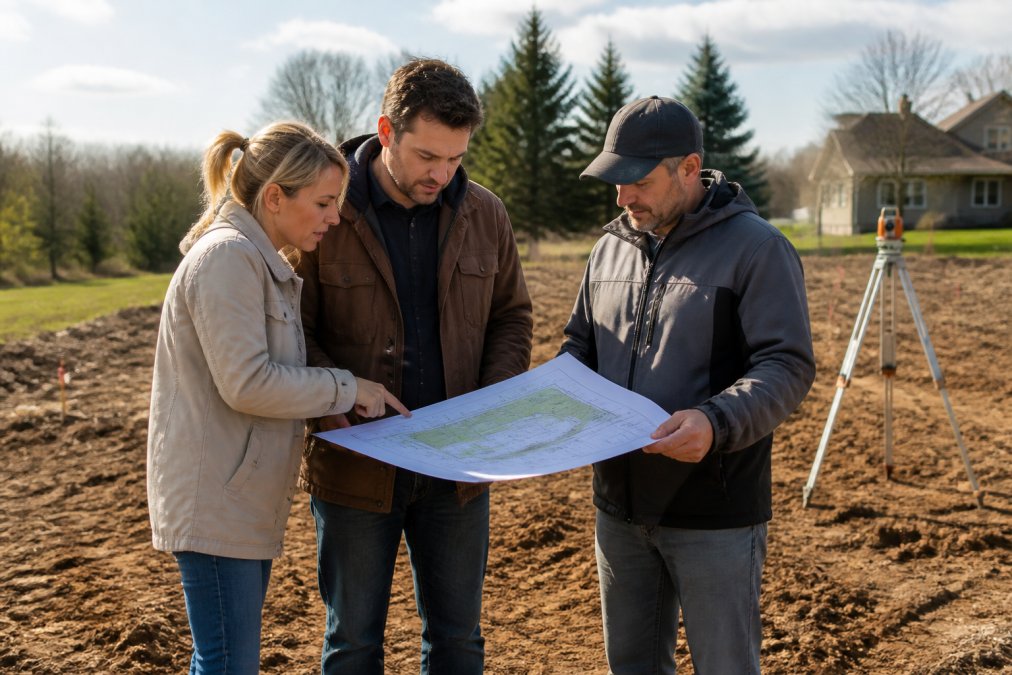
Request a detailed cost breakdown from your builder itemizing labor, materials, subcontractors, permits, inspections, and contingencies. A contractor who won't provide this level of detail is a red flag. At Timeless General Contracting, we provide transparent cost breakdowns upfront so clients understand exactly what they're financing.
Verify your builder's credentials. In Canada, look for Red Seal certification, which indicates the builder has met national standards for construction trades. Check references from previous builds, specifically asking about whether projects finished on schedule and on budget.
The builder contract should specify the draw schedule, typically occurring at key milestones: foundation completion, framing completion, roof completion, mechanical rough-in, drywall completion, and final inspection. Each draw requires a site inspection by the lender or a third-party inspector to verify work completion before funds are released.
How Progress Draw Mortgages Work for Your Build
A progress draw mortgage disburses funds in stages as your build progresses. This is the standard financing structure for construction mortgages in Canada.
Here's the typical flow: you close on your land with your down payment. Your lender approves a construction mortgage for the remaining amount. The builder submits a draw request when a milestone is complete. The lender orders an inspection to verify the work matches the builder contract. Once verified, the lender releases funds directly to the builder or into an escrow account.
You are responsible for paying interest on the drawn amount during construction. If your lender has released $100,000 in draws, you pay interest only on that $100,000, not the full loan amount.
Draw requests typically include invoices from the builder, proof of payment to subcontractors, and a summary of work completed. Some lenders require a statutory declaration from the builder confirming that all suppliers and subcontractors have been paid. This protects the lender (and you) from mechanic's liens.
The lender will also require a cost-to-complete estimate at each draw stage. If the cost-to-complete exceeds your remaining loan amount, the lender may withhold the draw until you provide additional funds or reduce the scope of work.
A lien holdback is another critical component. Most lenders hold back 10% of each draw and release it only after a statutory holdback period (typically 45 days) has passed. This protects against mechanic's liens from suppliers or subcontractors who claim they weren't paid.
Step 3: Plan Your Contingency Budget and Manage Draw Requests
A contingency budget is money set aside for unexpected costs. Soil conditions may require additional foundation work. Structural issues discovered during framing may require engineering solutions. Material prices may increase between your contract date and your build date.
Industry practice suggests a contingency reserve of 5-10% of your total construction cost. For a $400,000 build, that's $20,000-$40,000. This contingency should be part of your total project cost and included in your mortgage application.
Ideally, fund your contingency from your own savings. Some lenders will allow you to borrow part of your contingency as part of the construction mortgage, but this increases your debt and reduces your equity cushion.
When unexpected costs arise, document them carefully. Get a written change order from your builder that specifies the additional work, cost, and timeline impact. Submit this to your lender along with your next draw request.
Managing draw requests effectively requires coordination between you, your builder, and your lender. Submit draw requests promptly with complete documentation. Respond quickly to lender requests for additional information. A typical draw approval takes 5-10 business days from submission to fund release.
Step 4: Convert to Permanent Financing and Close
Once construction is complete and your builder has obtained your occupancy permit, your construction mortgage converts to permanent financing.
Permanent financing can be a fixed-rate mortgage (your rate is locked for the term, typically 5 years) or a variable-rate mortgage (your rate fluctuates with prime rate changes). Fixed rates provide payment certainty; variable rates are typically lower initially but carry rate-increase risk.
Before conversion, your lender will order a final appraisal of the completed home. This appraisal determines the home's value and ensures it meets the lender's lending standards. If the appraisal comes in lower than your total project cost, you may need to bring additional funds to close.
The conversion process involves finalizing your permanent mortgage terms, locking in your rate, and scheduling your closing date. Your lender will provide a mortgage commitment letter outlining the loan amount, rate, term, and conditions.
Closing costs for permanent financing typically include legal fees, title insurance, property tax adjustments, and lender fees. Budget $2,000-$4,000 for these costs. Your lawyer will coordinate the closing, register your mortgage with the provincial land registry, and transfer funds.
At closing, you'll sign your mortgage documents and receive the keys to your new home. Your construction mortgage is paid off, and your permanent mortgage begins.
Common Mistakes to Avoid When Financing Your Custom Build
The biggest mistake custom home buyers make is underestimating total project costs. They budget for construction but forget to include the land purchase, permits, professional fees, inspections, insurance, property taxes during construction, and a contingency reserve. By the time they're halfway through the build, they've run out of financing.
Another frequent error is choosing a builder based solely on price. The cheapest bid often reflects corner-cutting or underestimation of actual costs. A builder with transparent pricing, a strong track record, and Red Seal certification is worth the premium.
Many buyers fail to lock in their permanent financing rate early enough. Interest rates can change rapidly. Some lenders allow you to lock in your permanent rate when you close on the construction mortgage, which provides certainty.
Inadequate contingency reserves are another trap. Buyers who set aside only 2-3% for contingencies run out of funds when unexpected costs arise. A 5-10% contingency reserve is standard practice for a reason.
Not verifying your builder's credentials is a serious risk. Before signing a contract, verify Red Seal certification, check references, and confirm that the builder carries liability insurance and workers' compensation coverage.
Finally, many buyers don't understand their lender's draw approval process and timelines. They submit incomplete draw requests, miss documentation deadlines, or fail to respond to lender questions promptly. This delays draws, which delays construction and increases your interest costs.
Financing a custom home build is complex, but it's manageable with proper planning and the right team. The key is understanding how construction mortgages differ from traditional mortgages, securing pre-approval before committing to land or a builder, and maintaining clear communication with your lender and builder throughout the process.
At Timeless General Contracting, we've guided clients through this process for 25 years. Our transparent approach to project management, combined with our Red Seal certification and Client Project Portal for real-time build tracking, ensures you stay informed at every stage. When you're ready to move forward with your custom home build in Pictou County, we're here to help you navigate the financing and construction process with confidence.
| Stage | Key Action | Timeline | Responsible Party |
|---|---|---|---|
| Pre-approval | Get credit checked, verify income, lock rate | 3-5 days | You + Lender |
| Land acquisition | Survey, title search, make offer | 2-4 weeks | You + Real estate agent |
| Builder contract | Finalize scope, cost, timeline, draw schedule | 2-4 weeks | You + Builder |
| Construction phase | Monitor draws, submit requests, attend inspections | 6-12 months | Builder + Lender inspector |
| Conversion | Final appraisal, permanent mortgage terms, closing | 2-4 weeks | You + Lender + Lawyer |
Frequently Asked Questions
What is the difference between a construction mortgage and a standard mortgage in Canada?
A construction mortgage in Canada is structured differently than a traditional mortgage. With a construction mortgage, you borrow funds in stages through progress draws as your build progresses, rather than receiving the full amount upfront. You typically pay interest-only on the amount drawn during construction, and the loan converts to a permanent fixed-rate or variable-rate mortgage once the home is complete. This approach protects both you and the lender by ensuring funds are released only when work meets agreed-upon milestones.
How much down payment do I need for a custom home build in Canada?
Down payment requirements for custom home builds typically range from 20% to 25% of the total project cost, though some lenders may accept 15% with mortgage insurance. The down payment usually covers land acquisition, permits, and initial construction costs. Your exact requirement depends on your credit score, debt-to-income ratio, and the lender's underwriting criteria. Speak with a mortgage advisor to determine what you'll need based on your specific financial situation and project scope.
What documents do I need to provide for a construction mortgage application in Canada?
Lenders typically require proof of income (recent tax returns, pay stubs, employment letters), a detailed builder contract with cost breakdowns, architectural plans or detailed specifications, proof of land ownership or purchase agreement, property appraisal, identification, and a credit report authorization. You may also need to provide a project timeline and a detailed budget showing cost-to-complete estimates. Having these documents organized and ready speeds up the pre-approval process significantly.
Do I need to own the land before applying for a construction mortgage?
No, you don't need to own the land outright, but you must have a purchase agreement or clear ownership path in place. Most lenders will accept a signed purchase agreement for the land as part of your application. Once approved, the construction mortgage funds can cover both the land acquisition and the build costs. However, some lenders prefer you to own the land free and clear before construction begins, so confirm this requirement with your mortgage advisor early in the process.
This article was written using GrandRanker