 ultimate-guide
Custom Home Building Costs in Pictou County: 2026 Guide
Table of Contents
- Understanding Custom Home Building Costs in Pictou County
- Hard Costs vs. Soft Costs: Where Your Budget Goes
- Cost to Build a House in Nova Scotia 2026
- Pictou County Building Permit Fees and Site Preparation
- Land Development Costs Nova Scotia: Foundation and Utilities
- Modular vs Stick-Built Home Costs Canada: Which Fits Pictou County
- Pictou County-Specific Factors: Zoning, Soil, and Local Labor
- Construction Timeline and Cost Control
Last Updated: August 5, 2026
Understanding Custom Home Building Costs in Pictou County
Custom home building costs in Pictou County vary significantly based on design complexity, site conditions, and material choices. Your investment depends on whether you're building on prepared land or managing raw site development, choosing modular or traditional stick-built construction, and incorporating energy efficiency upgrades for Nova Scotia's climate.
At Timeless General Contracting, we've guided homeowners through understanding where their budget actually goes. Most prospective builders arrive with a single number in mind without understanding the breakdown between the physical structure and everything required to make that structure functional on a specific piece of land.
Your custom home building costs include hard costs (tangible materials and labor for the structure), soft costs (permits, design, financing, and professional fees), site preparation (foundation work, utilities, driveway), and regional factors specific to Pictou County's geography, zoning, and labor market.
Hard Costs vs. Soft Costs: Where Your Budget Goes
Hard costs are the materials, labor, and equipment that create the physical structure. Soft costs are everything else: professional services, permits, insurance, and financing that make the project legally and financially possible.
Hard Costs Explained
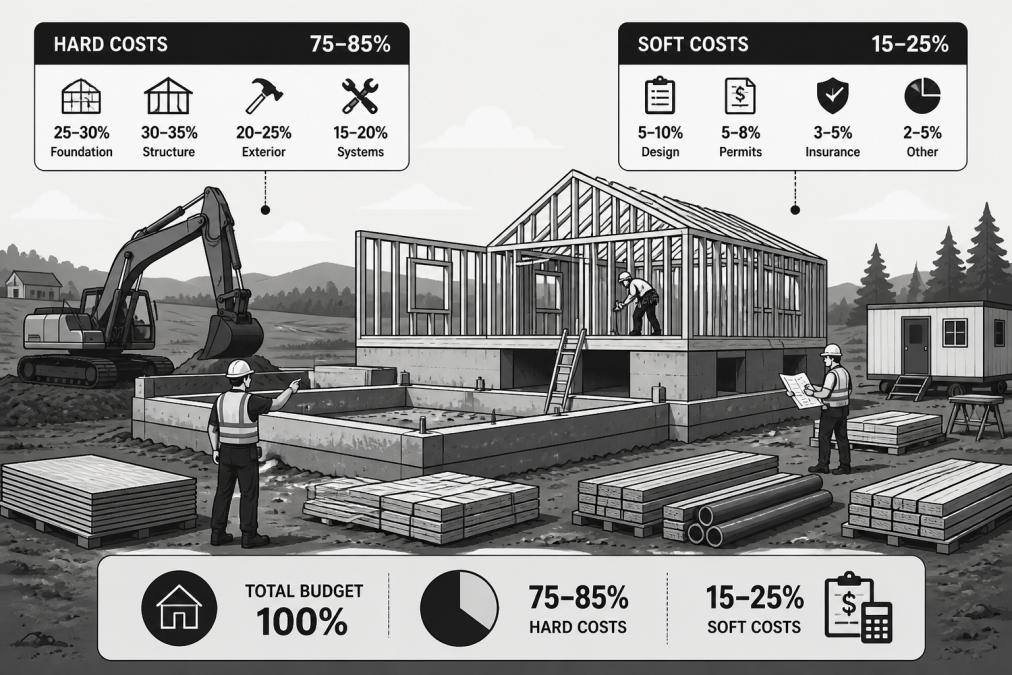
Hard costs are the construction expenses you can physically see and touch: framing lumber, concrete, roofing materials, electrical wiring, plumbing fixtures, HVAC systems, windows, doors, insulation, drywall, flooring, and skilled trades labor. These costs typically represent 70-80% of your total project budget.
The breakdown within hard costs varies by home size and finish level. Foundation work (excavation, concrete, drainage) usually accounts for 8-12% of hard costs. Framing and structural systems take 15-20%. Exterior finishing (roofing, siding, windows) runs 12-15%. Interior systems (electrical, plumbing, HVAC) consume 15-18%. Finishing materials (drywall, flooring, cabinetry, paint) account for 20-25%.
Material escalation is critical. Lumber prices fluctuate based on market conditions and supply chain availability. A 10-15% contingency for material cost increases is prudent when locking in budgets more than six months before construction begins.
Labor costs for custom home building in Pictou County depend on subcontractor availability and project complexity. Red Seal certified trades (electricians, plumbers, HVAC technicians) command higher rates but their expertise directly impacts code compliance and long-term performance. Rural Pictou County has a tighter labor market than urban Halifax, affecting both availability and pricing for specialized work.
Soft Costs and Hidden Expenses
Soft costs are the non-construction expenses that enable your project to proceed legally and financially: architectural design fees, building permits and inspections, property survey and site assessment, construction financing costs, insurance, and professional project management.
Architectural design fees for a custom home typically range from 8-12% of hard costs, depending on design complexity. Building permits and inspections are mandatory; permit costs typically range from 0.5-1.5% of project value, though the real cost is in timeline delays (4-8 weeks).
Construction financing carries costs beyond principal and interest. Construction mortgages often have interest-only payments during the build phase, then convert to standard amortization upon completion.
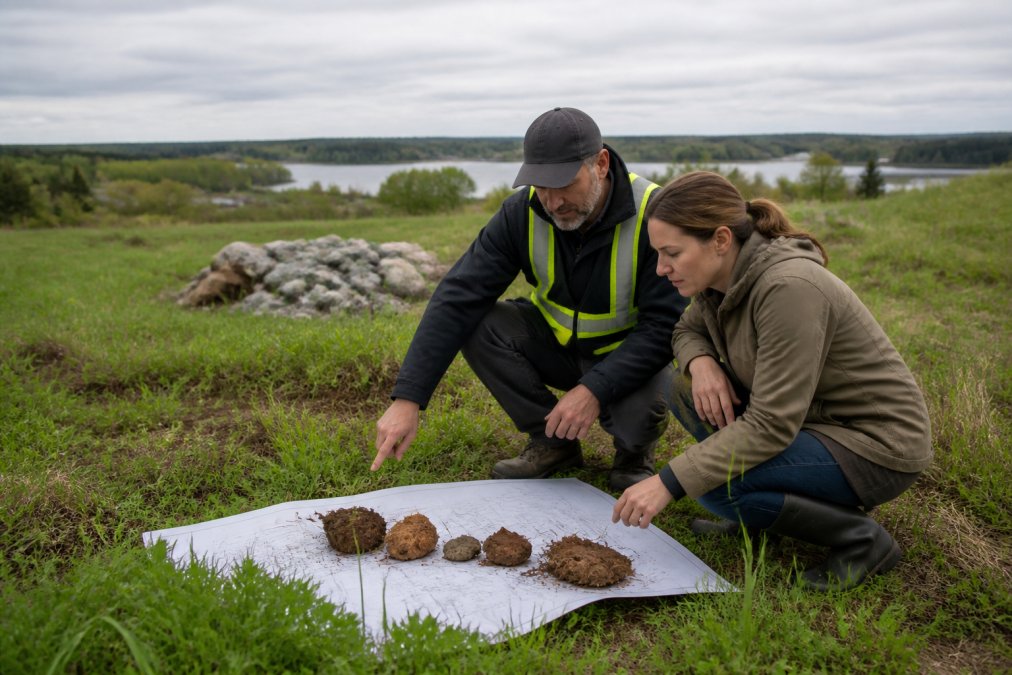
Property survey and site assessment costs are often overlooked. A professional survey establishes property boundaries and identifies easements. A geotechnical assessment (soil testing) is critical in Pictou County because soil conditions vary dramatically, some areas have stable clay, others have bedrock close to the surface, and some have poor drainage.
Insurance during construction protects both you and your contractor. Builder's risk insurance covers the structure while under construction; liability insurance protects against accidents on-site. These costs typically run 1-2% of hard costs.
Cost to Build a House in Nova Scotia 2026
The cost to build a house in Nova Scotia varies by region, home size, and finish level. Pictou County sits in the middle of Nova Scotia's cost spectrum, more affordable than urban Halifax but with higher costs than some rural areas due to specialized trades required for modern building code compliance.
Site conditions dramatically affect total costs. A property with existing utilities and level terrain costs far less to develop than raw land requiring well drilling, septic system installation, extensive grading, and long driveway construction. Many Pictou County properties are rural with no municipal utilities, making infrastructure development a significant cost factor.
Energy efficiency upgrades add upfront costs but reduce long-term operating expenses. Nova Scotia's climate (cold winters, variable spring/fall weather, coastal wind exposure) makes high-performance building envelopes economically sensible. Upgrading from standard insulation to superior insulation, installing high-efficiency HVAC systems, and using triple-glazed windows increases hard costs by 8-15%, but energy savings over 25 years typically exceed the additional investment.
Pictou County Building Permit Fees and Site Preparation
Building permits and site preparation are two distinct cost categories that must be planned separately, though they're closely related.
Building Permits and Inspections
Building permits in Nova Scotia are issued at the municipal level. Pictou County municipalities each have their own permit requirements and fee structures. The permit process typically takes 4-8 weeks and requires submission of construction documents demonstrating compliance with the National Building Code of Canada as adopted by Nova Scotia.
Inspections occur at critical stages: foundation, framing, rough-in (mechanical and electrical before drywall), insulation, and final. In Pictou County, if your property requires a septic system (most rural properties do), the Department of Natural Resources requires septic system design approval before you can obtain a building permit, adding 2-4 weeks to the permitting timeline.
Site Preparation and Infrastructure
Site preparation transforms raw land into a buildable property, including excavation and grading, foundation preparation, driveway construction, and utility infrastructure (well, septic, electrical service entrance).
Excavation and grading costs depend on terrain slope, soil conditions, and material volume. Pictou County's varied topography means some sites are straightforward, while others demand extensive earthwork.
Driveway construction is often underestimated. A typical 150-meter driveway in Pictou County with gravel base, crushed stone, and asphalt paving runs higher than expected due to distance and local material costs.
Well drilling is required if municipal water isn't available. The depth to usable groundwater in Pictou County varies dramatically by location. A professional well contractor will conduct a site assessment to estimate depth and yield before drilling.
Septic system installation includes the tank, distribution lines, and leach field. Nova Scotia's Department of Natural Resources requires a soil evaluation and professional design before installation. Installation costs vary based on site conditions; straightforward installations on suitable soil cost less than engineered solutions on marginal soil.
Electrical service entrance and utility connections must be coordinated with Nova Scotia Power. The distance from the property line to the building affects trenching costs.
Land Development Costs Nova Scotia: Foundation and Utilities
Land development costs in Nova Scotia, specifically the foundation and utilities components, represent a significant portion of your total budget and demand careful planning in Pictou County.
Foundation types vary by soil conditions and building design. A standard concrete slab-on-grade works well on stable, well-drained soil. A basement requires deeper excavation and more extensive concrete work but provides additional living space. Bedrock is common in parts of Pictou County; if excavation hits bedrock close to the surface, blasting or specialized excavation equipment becomes necessary, significantly increasing costs. A geotechnical assessment before finalizing your foundation design prevents expensive surprises.
Utilities infrastructure is the largest hidden cost for rural Pictou County properties. Municipal water and sewer systems are available in villages and towns but absent in rural areas, which require private wells and septic systems.
Well development includes drilling, testing, and installation of a submersible pump and pressure tank. The pump delivers water to your home; the pressure tank maintains consistent water pressure.
Septic system design and installation is governed by Nova Scotia's On-Site Sewage Disposal Guidelines. A professional designer evaluates soil permeability, groundwater depth, and property slope to determine the appropriate system type. Standard systems work on suitable soil; engineered systems (sand mounds, pressure distribution) are required on marginal soil and cost substantially more.
Electrical service entrance installation connects your home to Nova Scotia Power's distribution network. The cost depends on distance from the nearest power line and whether underground burial is required.
Propane or natural gas heating is common in Pictou County. If natural gas isn't available (it isn't in most rural areas), propane requires tank installation and regular delivery service. Heat pump systems (increasingly popular for energy efficiency) reduce heating fuel needs but require proper electrical infrastructure.
Modular vs Stick-Built Home Costs Canada: Which Fits Pictou County
The choice between modular (factory-built) and stick-built (site-built) construction affects both your budget and timeline.
Modular homes are built in a factory under controlled conditions, then transported to the site and assembled. The factory environment allows precise manufacturing, reduced material waste, and faster construction timelines. Modular construction typically costs 10-15% less per square foot than stick-built custom homes. However, site preparation, foundation, utility connections, and finishing work still occur on-site. Transportation costs from the factory to Pictou County can be substantial if the factory is distant.
Stick-built homes are constructed entirely on-site by local trades. This approach allows complete design customization and eliminates transportation constraints. However, stick-built construction is weather-dependent, labor-intensive, and subject to material escalation during the build period.
For Pictou County specifically, stick-built custom construction has advantages. Local trades understand regional soil conditions, building code requirements, and climate-specific construction details. Custom designs reflecting local architectural character are easier to achieve with stick-built construction.
Timeline is a key differentiator. Modular homes typically take 6-8 months from order to occupancy. Stick-built custom homes typically take 10-14 months, depending on complexity and permit timelines.
Pictou County-Specific Factors: Zoning, Soil, and Local Labor
Pictou County presents unique building challenges and opportunities that directly affect your custom home building costs and timeline.
Zoning bylaws vary by municipality within Pictou County. Rural areas typically allow residential construction on larger lots (1-5 acres) with fewer restrictions. Before purchasing land, confirm that your intended use complies with local zoning.
Soil conditions in Pictou County are highly variable. The county's geology includes glacial deposits, bedrock outcrops, and clay soils. Some areas have excellent drainage and stable foundations; others have poor drainage requiring engineered septic systems or foundation solutions. A professional geotechnical assessment before finalizing your design prevents costly foundation redesigns mid-project.
Bedrock depth varies dramatically. Some properties have bedrock at 2-3 meters; others have 10+ meters of overburden. Shallow bedrock requires blasting or specialized excavation, significantly increasing site preparation costs.
Water table elevation affects septic system design and basement feasibility. High water tables (common in some areas) limit basement options and require engineered septic solutions.
Local labor availability in Pictou County is adequate but not abundant. Red Seal certified trades are the gold standard. Timeless General Contracting's Red Seal certification ensures that your project meets the highest professional standards.
Supply chain logistics affect material costs. Pictou County's rural location means longer delivery times for specialized materials. Some specialty items may require extended lead times.
Energy efficiency and climate considerations are increasingly important in Pictou County. The region experiences cold winters, variable spring and fall weather, and coastal wind exposure. Building to high-performance standards costs more upfront but reduces long-term heating costs and improves comfort.
Construction Timeline and Cost Control
The timeline for custom home building in Pictou County typically spans 10-14 months from permit approval to occupancy, though this varies based on design complexity, permit delays, and seasonal factors.
Permit approval takes 4-8 weeks in most Pictou County municipalities. If your property requires septic system approval (which most rural properties do), add another 2-4 weeks. Site assessment and design refinement take 4-6 weeks before permits are even submitted.
Foundation and site preparation take 4-8 weeks, depending on excavation complexity and weather. Framing and structural work take 6-8 weeks for a typical custom home. Rough-in (mechanical, electrical, plumbing) takes 4-6 weeks and must be completed and inspected before drywall installation. Drywall, finishing, and interior work take 8-12 weeks depending on finish level and complexity. Final inspections and punch-list work take 2-4 weeks.
Cost control during construction requires clear contracts, regular communication, and proactive management. A fixed-price contract protects you from cost overruns but should include a reasonable contingency (5-10%) for unforeseen conditions.
Change orders are the primary driver of cost overruns. Every design change, material upgrade, or scope addition must be documented and priced before work begins. Timeless General Contracting's Client Project Portal provides real-time visibility into project progress, material orders, and budget status, reducing surprises and enabling informed decisions before costs escalate.
Regular site meetings (weekly or bi-weekly) keep all parties aligned and catch issues early. Weather delays are inevitable in Pictou County. Building during the optimal season (May through September) minimizes weather impact, though it increases competition for trades and materials.
Building a custom home in Pictou County is a significant undertaking that demands clear understanding of costs, timelines, and regional factors. The investment in professional guidance, from geotechnical assessment through final inspection, pays dividends in avoiding costly surprises and ensuring your home meets both code requirements and your long-term expectations. Timeless General Contracting brings 25 years of Pictou County-specific experience and Red Seal certification to manage your project with transparency and expertise. Our Client Project Portal keeps you informed at every stage, from permit approval through final walkthrough, ensuring your custom home is completed on time and within budget. Nova Scotia Building Code requirements and Department of Natural Resources septic system guidelines provide the regulatory framework; professional execution delivers the result.
Frequently Asked Questions
How much does it cost to build a custom home in Pictou County?
Custom home building costs in Pictou County depend on square footage, design complexity, site conditions, and material choices. Hard costs (labor, materials, equipment) typically form the largest portion, while soft costs (permits, design, financing) add 15-25%. Regional factors like soil conditions, zoning requirements, and local labor availability also influence the final price. Contact Timeless General Contracting for a detailed quote based on your specific project scope and site conditions.
What is the current cost per square foot to build a home in Nova Scotia?
Cost per square foot varies significantly across Nova Scotia based on location, complexity, and finishes. Rural areas like Pictou County may have different costs than urban centers due to labor availability and site preparation requirements. Production builds typically cost less per square foot than fully custom homes. For an accurate estimate tailored to Pictou County's specific conditions and your design preferences, request a consultation with an experienced local contractor.
What permits are required for custom home building in Pictou County?
Custom home building in Pictou County requires building permits from the municipal authority, which cover structural work, electrical, plumbing, and HVAC systems. You may also need land development permits, zoning approvals, and environmental assessments depending on your site. Well and septic permits apply for rural properties. An experienced contractor like Timeless General Contracting manages the permit process, ensuring compliance with local building codes and timeline expectations.
Is it cheaper to build a modular home or a stick-built home in Nova Scotia?
Modular homes typically offer cost savings through factory efficiency and reduced on-site labor, but this advantage depends on design complexity and site accessibility in Pictou County. Stick-built homes offer greater customization and may be more cost-effective for complex designs or challenging sites. Both approaches have merit; the best choice depends on your timeline, budget, and design goals. A Red Seal certified contractor can provide a transparent comparison for your specific project.
What is included in soft costs for custom home building?
Soft costs include architectural design fees, engineering, building permits and inspections, construction financing, insurance, surveying, and project management. These typically represent 15-25% of total project costs. In Pictou County, additional soft costs may include zoning applications and environmental assessments. Understanding soft costs upfront helps prevent budget surprises and ensures transparent project planning.
How do I prevent cost overruns and scope creep in a custom home project?
Establish a detailed fixed-price contract or cost-plus agreement with clear scope definition before construction begins. Regular communication with your contractor through project management tools like Timeless General Contracting's Client Project Portal helps track changes in real-time. Document all change requests and their costs. A transparent contractor provides regular budget updates and explains cost implications before changes are made.
Are there specific zoning or soil conditions in Pictou County that affect building costs?
Yes. Pictou County's rural character means varying zoning bylaws, soil composition, and foundation requirements across the region. Some sites require specialized excavation, different foundation types, or additional site preparation. Well and septic systems add infrastructure costs for rural properties. A site survey and geotechnical assessment early in planning reveal these factors and help estimate realistic costs for your specific location.
This article was written using GrandRanker