 ultimate-guide
Cost of Building a Custom Home: 2026 Guide
Table of Contents
- Understanding the Cost of Building a Custom Home
- Key Factors Influencing Construction Costs
- Hidden Costs Custom Home Builders Often Miss
- Financing Your Custom Home in Canada
- Custom Home Building Timeline in Canada
- Post-Construction Costs and Long-Term Ownership Expenses
- Green Building and Energy-Efficient Premiums
- Cost of Building a Custom Home: Working with Contractors
Last Updated: July 23, 2026
Understanding the cost of building a custom home requires navigating complex expenses, timelines, and regional variables. At Timeless General Contracting, we've guided hundreds of families through this process. Most homeowners underestimate costs by 15-25% by missing hidden expenses that emerge during construction. This guide breaks down where your money goes, how to plan realistically, and how to protect yourself from scope creep and unexpected bills.
Hard Costs vs. Soft Costs Explained
Hard costs are tangible expenses: lumber, concrete, electrical wiring, plumbing fixtures, roofing materials, and labor. These typically represent 70-80% of your total budget. Soft costs are everything else: architectural design fees, engineering reports, permits, property surveys, insurance during construction, and financing charges.
A typical custom home with $400,000 in hard costs might carry $80,000-$120,000 in soft costs depending on site complexity and local regulations. Hard costs break down further into labor (35-45%) and materials (55-65%), while soft costs are often fixed: permits cost what they cost, architectural fees are negotiated upfront, and financing charges depend on your loan structure and timeline.
Cost Per Square Foot in Canada
Cost per square foot is a useful starting metric but deceptively misleading if used alone. A typical custom home in Canada costs $150-$250 per square foot for hard costs, but this obscures massive regional and quality variations. A 2,000-square-foot home in rural Pictou County might cost $300,000-$400,000, while the same home in Toronto or Vancouver could run $500,000-$700,000 or more.
The metric fails because it doesn't account for complexity. A simple rectangular home with standard finishes costs less per square foot than an architecturally complex design with multiple roof lines, large open spaces, and high-end finishes.
| Cost Per Square Foot (Hard Costs) | Region/Condition | Typical Home Size | Estimated Total Hard Cost |
|---|---|---|---|
| $150-$180 | Rural Atlantic Canada | 2,000 sq ft | $300,000-$360,000 |
| $180-$220 | Mid-size cities (Maritimes/Prairies) | 2,000 sq ft | $360,000-$440,000 |
| $220-$280 | Major urban centers (Toronto, Calgary) | 2,000 sq ft | $440,000-$560,000 |
| $280-$350+ | High-cost markets (Vancouver, Toronto downtown) | 2,000 sq ft | $560,000-$700,000+ |
These figures represent hard costs only and assume standard to mid-range finishes. Luxury finishes or complex architecture can push costs 20-40% higher.
Key Factors Influencing Construction Costs
Design complexity is the single largest variable you control. A simple rectangular footprint with a pitched roof costs significantly less than an L-shaped or T-shaped design with multiple roof lines and vaulted ceilings.
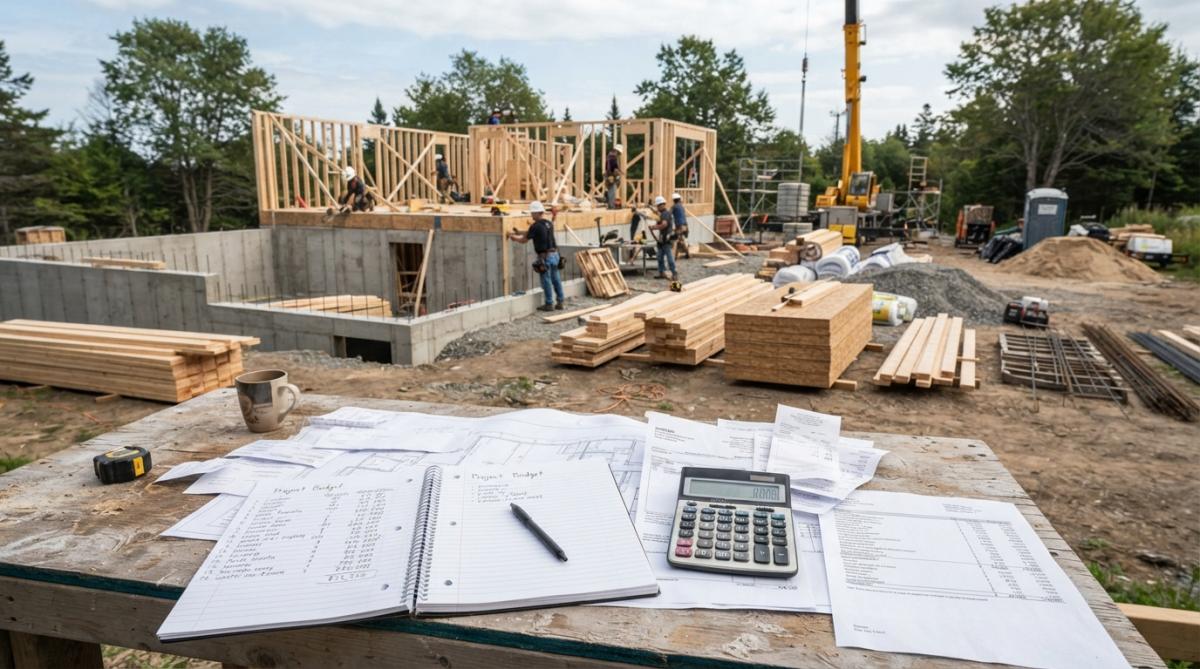
Material quality creates a second major cost lever. Choosing between vinyl windows and triple-glazed fiberglass windows might represent a $10,000-$20,000 difference on a 2,000-square-foot home. Roofing material choices, asphalt shingles versus cedar shake versus metal, can swing costs by $15,000-$30,000.
Site conditions dramatically affect your budget. A flat, accessible lot with stable soil costs less than a sloped lot requiring extensive grading, retaining walls, or geotechnical work. A rural lot requiring a well, septic system, and long driveway adds $30,000-$80,000 before construction begins. Poor soil conditions requiring deep foundations can add another $20,000-$50,000.
Labor rates vary by region and trade. During peak building seasons, trades command premium rates or book out months in advance. A project delayed by six months waiting for the right electrician isn't just a schedule issue, it's a cost issue due to financing charges, insurance, and potential material price increases.
Hidden Costs Custom Home Builders Often Miss
Scope creep, the slow expansion of the project beyond the original plan, is the primary budget killer. A homeowner decides to upgrade flooring in the master bedroom, then extend the deck, then shift the kitchen layout. Each change seems small, but collectively they represent thousands of dollars and weeks of delay. A 10% scope creep on a $500,000 project is $50,000 in unplanned costs.
Industry standard is a 10-15% contingency reserve for unknowns. On a $400,000 hard-cost project, that's $40,000-$60,000 sitting in reserve. This isn't optional, it's insurance against foundation discoveries requiring additional reinforcement, structural issues uncovered during framing, or soil conditions demanding different drainage solutions.
Permit and impact fees vary wildly by municipality but are often underestimated. A building permit might cost $2,000 in one jurisdiction and $8,000 in another. Impact fees for schools, roads, and utilities can add another $5,000-$25,000.
Design changes during construction are expensive. Moving a wall after framing is complete means paying for removal, rerouting electrical and plumbing, and labor disruption, a seemingly minor change becomes a $5,000-$15,000 change order.
Financing costs are substantial and often overlooked. A construction loan typically charges interest-only payments during the building phase. On a $500,000 loan at 7% interest over 12 months, you're paying roughly $35,000 in interest before moving in.
Site Preparation and Land Acquisition
What you do with the land directly impacts construction costs. A lot that's already cleared, graded, and accessible costs far less than a forested lot requiring clearing or a sloped lot requiring extensive grading and retaining walls.
Site preparation includes survey work, soil testing, clearing and grading, drainage work, and access road construction. On a straightforward suburban lot, this might total $8,000-$15,000. On a challenging site, it can reach $40,000-$80,000 or more.
Utility connections vary dramatically. Connecting to municipal water and sewer is relatively inexpensive if you're close to existing infrastructure. A rural lot requiring a well and septic system adds $15,000-$35,000. Electrical service might require a new transformer or service upgrade, adding another $5,000-$15,000. A private driveway costs $5,000-$20,000 depending on length and surface type.
Permits, Impact Fees, and Building Code Compliance
Building permits are required in every Canadian jurisdiction and typically range from $2,000-$8,000 for a residential custom home. The permit process requires architectural and engineering drawings that meet code standards, an additional $5,000-$15,000 if you haven't already commissioned them.
Impact fees (also called development charges) are levied by municipalities to offset the cost of providing services to new development. In rapidly growing areas, impact fees can total $10,000-$25,000 or more. Check with your municipality early in planning, these fees are non-negotiable.
Building code compliance requires inspections at multiple stages: foundation, framing, rough-in, and final. Each inspection costs $200-$500 and requires scheduling around the inspector's availability. Missing an inspection schedule can delay your project by weeks.
Energy code compliance has become increasingly stringent. Modern Canadian building codes require higher insulation values, air sealing standards, and efficient mechanical systems. These requirements add cost, typically $15,000-$30,000 on a custom home, but reduce long-term operating costs.
Financing Your Custom Home in Canada
Construction loans differ fundamentally from traditional mortgages. A mortgage is a lump-sum loan received at closing; a construction loan is drawn in stages as work progresses. You pay interest only on the amount drawn, not the full loan amount.
A typical construction loan works through a draw schedule. The contractor submits invoices and requests payment for completed work. The lender's inspector verifies that work is complete and meets specifications. The lender then releases funds, typically holding back 10% until final completion.
Construction loans typically carry higher interest rates than mortgages, often 1-2% higher. A construction loan at 7.5% on a $500,000 project drawn over 12 months costs roughly $18,750-$37,500 in interest, depending on the draw schedule. Once construction is complete, you refinance into a traditional mortgage at a lower rate.
Most lenders require a minimum 20% down payment for a construction loan. Budget management during construction requires discipline. A real-time project portal (like the one Timeless General Contracting uses) lets you track spending against budget, see invoices and change orders, and catch cost overruns before they become problems.
Custom Home Building Timeline in Canada
The cost of building a custom home is directly tied to timeline. A project that takes 14 months instead of 12 costs more in financing charges, insurance, and labor rate increases.
Planning and permitting typically takes 3-6 months depending on design complexity and municipal responsiveness. The actual construction phase typically takes 10-14 months for a standard 2,000-square-foot custom home: foundation work (4-6 weeks), framing (6-8 weeks), mechanical and electrical rough-in (4-6 weeks), drywall and finishing (8-12 weeks), and final systems and landscaping (4-6 weeks).
Delays during construction are common and costly. A trade shortage that prevents your electrician from starting on schedule can delay the entire project by weeks. Each week of delay costs roughly $3,000-$5,000 in financing charges, insurance, and labor inefficiency. Seasonal factors significantly impact Canadian construction timelines and costs. Summer construction is faster and cheaper because trades are available and weather is predictable.
Post-Construction Costs and Long-Term Ownership Expenses
The cost of building a custom home doesn't end at closing. New homes require maintenance, warranty work, and ongoing operating costs that many first-time builders underestimate. A newly constructed home typically has a one-year builder's warranty covering defects in workmanship and materials.
Maintenance costs for a new custom home typically total 1-2% of the home's value annually. On a $600,000 home, that's $6,000-$12,000 per year for routine maintenance: HVAC servicing, roof inspections, foundation monitoring, and seasonal upkeep.
Warranty work during the first year is common and should be expected. Drywall cracks appear as the home settles. Doors and windows shift slightly. A professional builder uses a transparent warranty process with a clear timeline for addressing issues.
Operating costs depend on the home's energy efficiency. A home built to current code standards with high-efficiency systems costs 20-30% less to operate than a home built to minimum code standards. Over 30 years, that's $15,000-$22,500 in avoided costs.
Green Building and Energy-Efficient Premiums
Building a custom home with energy efficiency in mind adds cost upfront but reduces long-term operating expenses significantly. High-performance HVAC systems cost 15-25% more than standard systems but reduce heating and cooling costs by 20-30%. Triple-glazed windows cost 30-40% more but reduce heating losses by 15-20%.
In Atlantic Canada, where heating costs are substantial, energy upgrades typically pay for themselves in 8-12 years through reduced operating costs. Heat pump systems are increasingly popular because they provide both heating and cooling while using 50-70% less energy than traditional furnace-and-air-conditioner systems. Over a 20-year lifespan, a heat pump system typically saves $15,000-$30,000 in energy costs.
Water efficiency features add modest cost (typically $3,000-$8,000) but reduce water consumption and sewage costs by 20-30%. In areas with high water rates or septic systems, these investments pay for themselves within 10-15 years.
Cost of Building a Custom Home: Working with Contractors
Selecting a contractor is the most important decision you'll make, because the contractor's experience, reliability, and transparency directly impact your final costs. A contractor who communicates clearly and manages scope prevents cost overruns.
Red Seal certification indicates that a contractor has met national standards for training, experience, and competency. Timeless General Contracting's Red Seal certification means the team has demonstrated expertise in building codes, safety standards, and construction practices. Verify credentials and ask for references from recent projects, actual homeowners you can contact directly.
Cost differences between contractors often reflect experience and overhead, not just labor rates. A contractor charging $50/hour might be less expensive than one charging $65/hour if the experienced contractor completes work in 40 hours versus 60 hours.
A real-time project portal transforms the contractor-homeowner relationship from periodic updates to continuous visibility. Timeless General Contracting's Client Project Portal lets you track invoices, change orders, progress photos, and schedule updates in real time. This transparency prevents surprises and allows you to spot potential issues before they become expensive problems.
General Contractor vs. Subcontractors: Cost Implications
A general contractor manages the entire project, coordinates subcontractors, and holds responsibility for quality and timeline. Subcontractors are specialists who handle specific trades: framing, electrical, plumbing, HVAC, roofing.
Hiring a general contractor costs more than hiring subcontractors directly, but the general contractor absorbs the coordination risk. If you hire subcontractors directly, you're responsible for scheduling, ensuring work quality, managing disputes, and handling cascading delays. This typically costs more in total.
General contractor fees typically range from 10-15% of hard costs. On a $400,000 hard-cost project, that's $40,000-$60,000. When comparing contractor quotes, ensure you're comparing the same scope. One quote might include project management and coordination; another might assume you're handling that yourself.
Real-Time Tracking and Transparency in Project Management
Construction projects are complex, with dozens of moving parts and hundreds of decisions. Without real-time visibility, cost overruns accumulate silently. A transparent project management system catches problems early.
Real-time tracking includes invoice visibility, allowing you to see exactly what work was completed and what you're paying for. It includes change order tracking, so you understand what's been added to the original scope and its cost impact. It includes progress photos and schedule updates.
The Client Project Portal at Timeless General Contracting provides this transparency. You can log in anytime, from any device, and see the current project status, upcoming milestones, recent invoices, and change orders. A contractor using transparent project management has nothing to hide and is signaling that they operate with integrity.
Schedule tracking is equally important. A project running two weeks behind schedule will incur additional financing costs, insurance costs, and potential labor rate increases. Early visibility of schedule delays allows you to make informed decisions about whether to add resources or accept the delay and its cost implications.
A project management system also serves as a documentation trail. If a dispute arises about what was promised versus what was delivered, the portal documents every conversation, every change order, and every invoice.
Building a custom home is one of the largest financial commitments most people make. The cost depends on dozens of variables, but the fundamental principle is simple: transparency and professional management prevent cost overruns and stress. Working with an experienced, Red Seal certified builder who provides real-time visibility into your project, like Timeless General Contracting, transforms the process from a source of anxiety into a manageable, predictable experience. The investment in professional oversight pays for itself many times over in avoided mistakes, prevented scope creep, and a home that's built right the first time.
Frequently Asked Questions
What is the average cost per square foot to build a custom home in Canada?
The cost per square foot to build a custom home in Canada varies significantly based on location, finishes, and complexity. Factors like regional labor rates, material availability, and site conditions influence pricing. For accurate estimates tailored to your specific project, consult with local builders who understand your region's market. Timeless General Contracting can provide detailed quotes based on your design and requirements.
What are the hidden costs when building a custom home in Canada?
Common hidden costs include site preparation, soil testing, permits and impact fees, architectural revisions, contingency overages, and post-construction finishing touches. Land acquisition costs, utility connections, and unexpected structural requirements can also add up. Building a contingency fund of 10-15% of your total budget helps manage these surprises. Working with an experienced general contractor who provides transparent cost breakdowns minimizes unexpected expenses.
How long does it take to build a custom home in Canada, and does timeline affect cost?
Custom home building timelines typically range from 12-24 months, depending on design complexity, permitting delays, and weather conditions. Longer timelines can increase costs due to extended labor, financing charges, and inflation impacts on materials. Efficient project management and clear communication with your contractor help keep both timeline and budget on track. Real-time project tracking tools can help identify delays early.
What financing options are available for building a custom home in Canada?
Construction loans are the primary financing option, offering funds in staged draws as work progresses. These differ from traditional mortgages and typically have variable interest rates during construction. Many lenders require a detailed budget and timeline. Once construction completes, you can refinance into a permanent mortgage. Discuss draw schedules and terms with your lender to align with your contractor's payment schedule and project phases.
This article was written using GrandRanker