 how-to
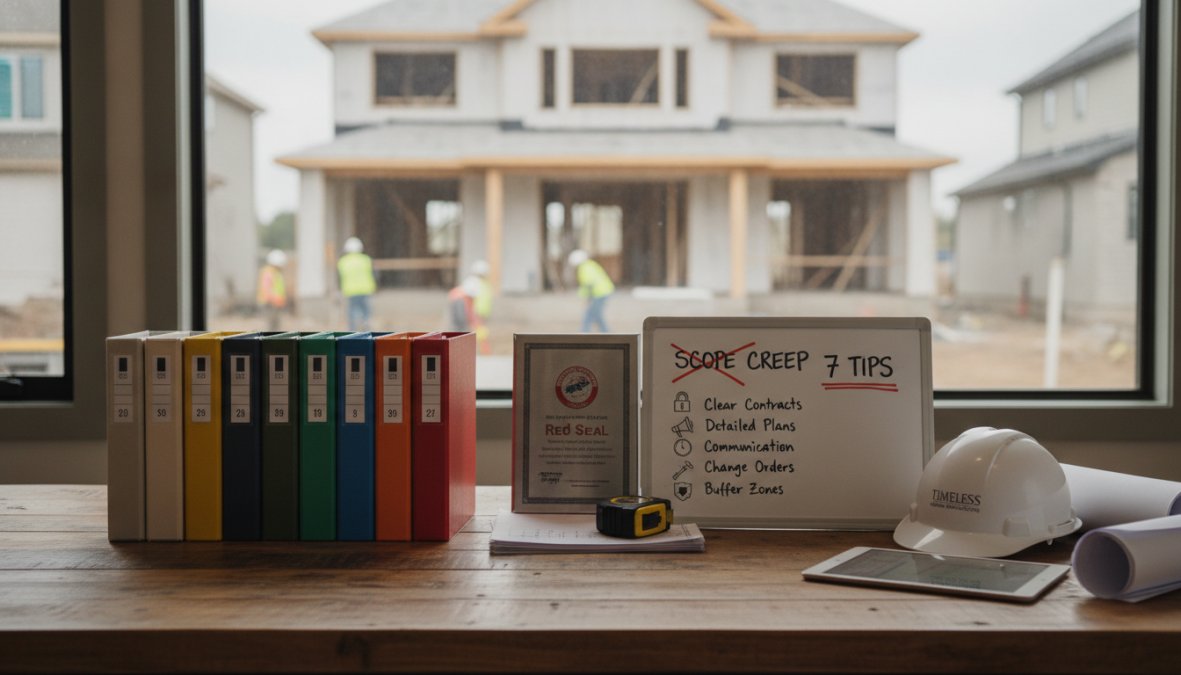
Avoiding Construction Scope Creep: 7 Tips That Work
Table of Contents
- What Is Scope Creep in Construction and Why It Matters
- Define Your Project Scope Clearly From the Start
- How to Write a Construction Scope of Work That Prevents Changes
- Establish a Formal Construction Change Order Process
- Managing Client Expectations in Construction Projects
- Construction Project Documentation Templates and Best Practices
- Psychological Triggers of Scope Creep and How to Counter Them
- Post-Project Analysis: Learning From Scope Creep Failures
Avoiding Construction Scope Creep: 7 Tips That Work
Last Updated: July 12, 2026
Construction projects that lose control of their scope typically experience budget overruns of 20-30% and timeline delays that frustrate both contractors and clients. Scope creep prevention is essential for construction professionals managing everything from residential renovations to large commercial builds. At Timeless General Contracting, we've spent 25 years helping clients maintain clear project boundaries. Below, we'll show you exactly how to define, document, and defend your project scope so changes stay controlled and profitability stays intact.
What Is Scope Creep in Construction and Why It Matters
Scope creep refers to uncontrolled expansion of a construction project beyond its original defined boundaries. It happens when clients request additional work, project managers fail to document changes formally, or stakeholders add features without adjusting timelines and budgets.
When a contractor absorbs extra work without formal change orders, labor schedules collapse, material orders become chaotic, and quality suffers. Subcontractors arrive expecting a certain scope and suddenly face expanded requirements. Equipment sits idle while crews scramble to accommodate last-minute requests.
How Scope Creep Impacts Budget and Timeline
Scope creep destroys budget and timeline simultaneously. When a client requests upgraded finishes mid-project, you're not just buying better materials, you're disrupting labor schedules, rescheduling trades, and potentially paying premium pricing for rush orders. Timeline impact is equally severe: construction operates on tight sequencing where electrical rough-in precedes drywall, plumbing precedes concrete pour. When scope expands, this sequence breaks. Trades arrive expecting the scheduled scope and instead find the project has changed, forcing them to other jobs. Getting them back becomes expensive or impossible.
Define Your Project Scope Clearly From the Start
The entire battle against scope creep is won or lost in the first two weeks of a project. If your project scope statement is vague or incomplete, scope creep becomes inevitable. Clear scope definition means writing down exactly what will be built, what won't be built, and what decisions have been made about materials, finishes, and specifications.
Creating a Detailed Project Scope Statement
A project scope statement is your legal and operational foundation. It must be detailed enough to eliminate ambiguity but concise enough that clients actually read it.
Your scope statement must include:
- Project description: What is being built (e.g., "Complete kitchen renovation including cabinetry, countertops, appliances, flooring, and lighting")
- Deliverables: Specific items that will be completed
- Inclusions: What IS covered (e.g., "Labor, materials, permits, inspections, disposal of existing materials")
- Exclusions: What is NOT covered (e.g., "Structural modifications, plumbing relocation beyond 5 feet, exterior work")
- Materials and finishes: Specific brands, grades, colors (e.g., "Granite countertops in Absolute Black, Kohler faucet model K-7549, Benjamin Moore paint in Chantilly Lace")
- Timeline: Start and end dates, key milestones
- Budget: Total project cost and payment schedule
- Change process: How changes will be requested, documented, and approved
Specificity matters enormously. "Quality flooring" is vague and invites disputes. "Luxury vinyl plank in medium oak finish, installed with moisture barrier, 1/4-inch underlayment" eliminates ambiguity.
How to Write a Construction Scope of Work That Prevents Changes
The scope of work (SOW) is the operational document that guides your project. It describes the actual work process: demolition sequence, material staging, trade coordination, cleanup standards, and quality checkpoints.
Setting Minimum Requirements and Project Constraints
Every project has constraints. Documenting these explicitly prevents clients from later claiming they didn't know about limitations.
Common constraints in construction include site access limitations, material lead times, structural limitations, regulatory requirements, seasonal limitations, and existing conditions like asbestos or mold. Documenting constraints upfront means clients understand why certain requests aren't possible or why they'll cost extra.
| Constraint Type | Example | Impact on Scope |
|---|---|---|
| Timeline | Project must complete by December 1 | Limits available work windows, affects trade scheduling |
| Budget | $150,000 fixed budget | Constrains material selections, may limit scope |
| Site Access | Work only 8am-4pm weekdays | Affects crew size, extends project duration |
| Materials | Tile requires 8-week lead time | Must be ordered before project starts, cannot be changed mid-project |
| Regulatory | Permits required for electrical work | Adds timeline, requires inspections, cannot skip steps |
Establish a Formal Construction Change Order Process
Most contractors fail here. They have a decent scope statement but no formal process for handling changes. A formal change order process means every change request is documented in writing, evaluated for cost and timeline impact before approval, signed off by the client with revised terms, and tracked so you know exactly what was added.
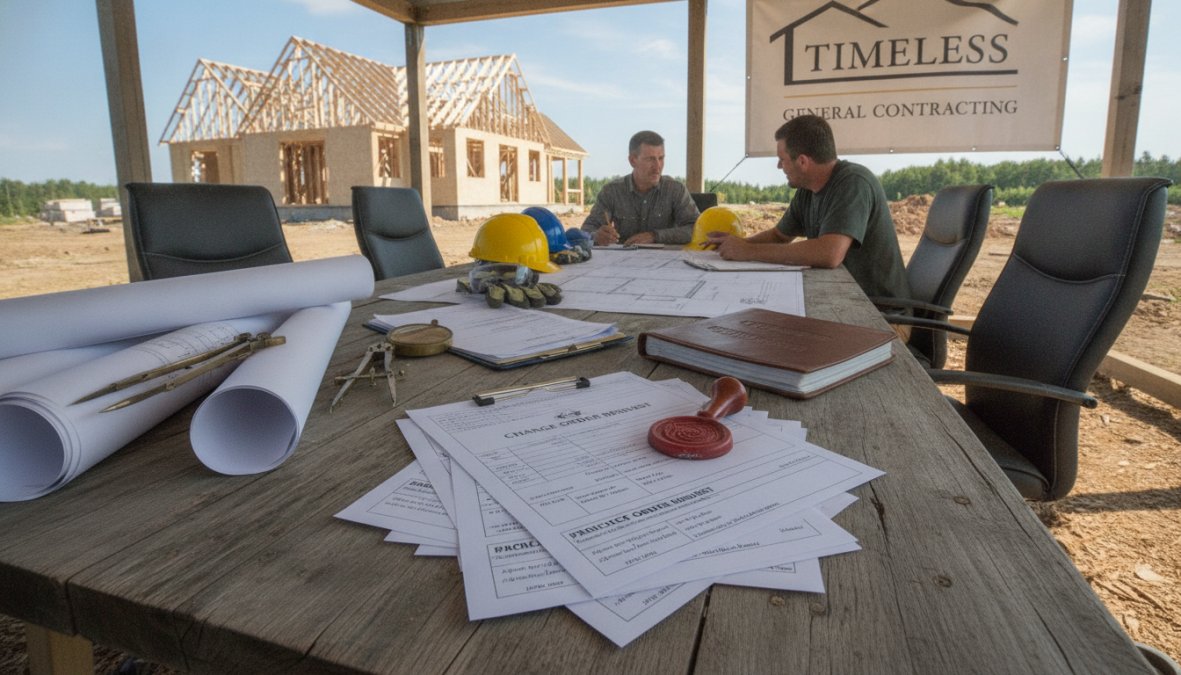
Without this process, you'll have arguments about what was promised. With it, you have a clear paper trail.
Using Change Order Templates for Documentation
A change order template forces both you and the client to think through the implications of a change. A good template includes change order number, project details, description of change, reason for change, cost impact (labor, materials, equipment, markup), timeline impact, new project total cost, new completion date, and signature lines.
The template forces you to quantify the impact before the client commits. Many clients will reconsider when they see that upgrading countertops adds $8,000 and delays the project by two weeks.
Here's a practical change order template you can adapt:
CHANGE ORDER
Project: [Project Name]
Address: [Address]
Change Order #: [Number]
Date: [Date]
Contractor: Timeless General Contracting
Description of Change:
[Specific description of what is being added, removed, or modified]
Reason for Change:
☐ Client Request
☐ Code Requirement
☐ Existing Condition Discovered
☐ Design Clarification
☐ Other: [Specify]
Cost Impact:
Materials: $[Amount]
Labor: $[Amount]
Equipment/Rental: $[Amount]
Contractor Markup (15%): $[Amount]
Total Change Cost: $[Amount]
Timeline Impact:
Days Added/Removed: [Number]
New Completion Date: [Date]
Original Contract Total: $[Amount]
Total Changes to Date: $[Amount]
New Project Total: $[Amount]
Approved By:
Client: _________________________ Date: _______
Contractor: _________________________ Date: _______
Managing Client Expectations in Construction Projects
Most scope creep isn't malicious. Clients often genuinely don't understand what was included in the original scope. Managing expectations means communicating clearly and repeatedly about what the project includes and doesn't include. Show clients the scope statement before work starts, walk through it line by line, and get explicit acknowledgment that they understand the boundaries.
Conducting Regular Scope Reviews and Stakeholder Alignment
Scope reviews are checkpoints where you verify that the project is tracking to the original scope and that no undocumented changes have crept in. These reviews should happen weekly for small projects, every two weeks for larger ones.
A scope review includes what has been completed, what's in progress, what's upcoming, changes to date, and any issues or concerns. Weekly job site meetings where you review progress against scope, discuss upcoming work, and surface questions keep everyone aligned. When a client raises a new idea, you can say "That's outside the current scope, let's document it as a change order."
Construction Project Documentation Templates and Best Practices
Documentation is your protection against scope creep. Essential documentation includes scope statement (signed by client), detailed specifications, project schedule, change orders (all approved changes, signed), meeting minutes, photo documentation, inspection records, and payment records.
The Role of Work Breakdown Structure in Scope Management
A Work Breakdown Structure (WBS) is a hierarchical breakdown of the project into smaller, manageable components. It's a visual way to organize scope so nothing gets missed and nothing gets added accidentally.
For a kitchen renovation, your WBS might include Demolition (remove cabinetry, countertops, flooring, fixtures, appliances), Rough-in Work (electrical, plumbing, HVAC), Finishes (cabinetry, countertops, flooring, backsplash, paint), Fixtures and Appliances (sink, faucet, appliances, lighting), and Final Details (hardware, caulking, cleanup).
The WBS serves as your scope checklist. Every item in the WBS is part of the original scope. Anything not in the WBS is a change. When a client asks for something, you reference the WBS: "That's not in the original scope breakdown, it would be a change order."
Psychological Triggers of Scope Creep and How to Counter Them
Understanding why scope creep happens helps you prevent it.
The "small addition" trap: Clients perceive small additions as inconsequential. They ask for one extra outlet, one additional light fixture, upgraded paint color. But your crew has already planned the electrical rough-in. Adding an outlet means rerouting wire, potentially relocating a junction box, and revising the electrical plan.
Counter: Explain the impact explicitly. "Adding that outlet requires rerouting electrical wire, which affects the rough-in schedule and adds two hours of labor. That's a $250 change order." When clients understand the cascading impact, they reconsider.
The scope creep by assumption: Clients often assume things are included when they're not. They assume "renovation" means all systems are upgraded.
Counter: Document assumptions explicitly. In your scope statement, list what is NOT included: "This scope does not include plumbing relocation, structural modifications, or HVAC upgrades."
The "while we're at it" request: Once a project starts, clients see opportunities. "While you're already here, could you also...?"
Counter: Create a clear process for "while we're at it" requests. Acknowledge them: "That's a good idea. Let me document it as a change order so we can evaluate the cost and timeline impact."
Post-Project Analysis: Learning From Scope Creep Failures
Every project teaches lessons. Projects that experienced scope creep should be analyzed to understand why and what to change for the next project.
A post-project analysis should answer: What scope creep occurred? When was it identified? Why did it happen? What was the financial impact? What would have prevented it? Track scope creep metrics over time: How many change orders per project? What's the average change order cost? What percentage of projects stay on scope? These metrics reveal patterns that guide process improvements.
Scope creep is predictable and preventable. The contractors who avoid it aren't luckier than others, they're more disciplined about documentation, clearer about communication, and more formal about change processes. Start with a detailed scope statement, establish a formal change order process, and conduct regular scope reviews. The discipline pays off in profitability, client satisfaction, and team morale.
Frequently Asked Questions
What is an example of scope creep in construction?
A common example: a homeowner requests upgraded flooring in one room during framing, then adds tile upgrades in the bathroom, then requests crown molding throughout, none originally in the contract. Each change individually seems small, but collectively they extend the timeline, increase labor costs, and delay project completion. Without a formal change order process, these requests blur the line between original deliverables and additions, making budget tracking difficult.
How do you manage scope creep using a construction change order process?
Establish a formal change order procedure that requires written documentation for any deviation from the original project scope statement. When a client requests changes, submit a change order detailing the scope modification, cost impact, timeline adjustment, and resource allocation required. Have the client sign and approve before work begins. This creates contractual obligations and prevents misunderstandings about what's included in the project.
What should be included in a construction scope of work to prevent changes?
A detailed scope of work must specify minimum requirements, exact deliverables, project constraints, materials to be used, finishes, and exclusions. Include a Work Breakdown Structure (WBS) that breaks the project into phases. Define what is NOT included (e.g., 'exterior painting not included'). Set clear project goals and objectives upfront. The more specific your documentation, the fewer ambiguities clients can later interpret as missing work.
Can scope creep be avoided entirely in construction projects?
While complete avoidance is unlikely, scope creep can be minimized significantly through proactive management. Clear project documentation, regular scope reviews, stakeholder alignment meetings, and a formal change control procedure reduce creep by 60-80% on well-managed projects. The key is treating scope management as an ongoing process, not a one-time activity at project kick-off. Transparent communication and realistic client expectations are your strongest mitigation strategies.
This article was written using GrandRanker